![“I wasn't discouraged by some of the obstacles we faced. I learned a lot from the leadership. I found that different people need different ways of receiving feedback — you can't [just] tell them to do something and expect the best. [Some] people needed more incentive. A large part of my role was to figure out what worked for everyone and to figure out how to lead all these separate individuals as a team,” Suhana Bhandare (’26) said.](https://harkeraquila.com/wp-content/uploads/2026/06/SuhanaBhandare_JasmineHansra-1-1200x798.jpg)

![“This is actually from Randy Pausch Randy P. Brick: ‘Walls are there for a reason. You have to show how much you want to overcome them.’ You have to show how much you want something. That's what I've always been able to do with tennis, Link Crew and getting that internship [with Kushy Baby]. It’s important pushing through that — getting around that brick wall, climbing over it or clawing through it,” Yash Sachdeva (’26) said.](https://harkeraquila.com/wp-content/uploads/2026/05/YashSachdeva_RamBatchu-copy-1200x1002.jpg)
















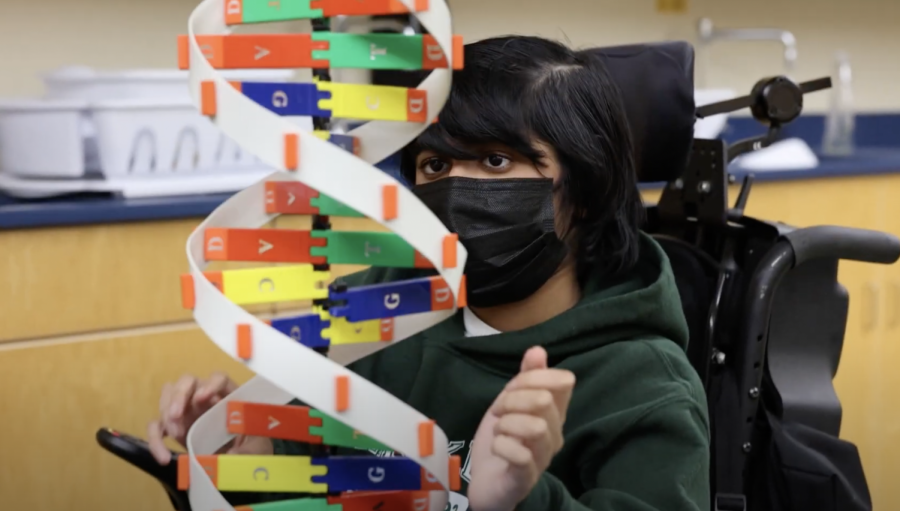
![“[Building nerf blasters] became this outlet of creativity for me that hasn't been matched by anything else. The process [of] making a build complete to your desire is such a painstakingly difficult process, but I've had to learn from [the skills needed from] soldering to proper painting. There's so many different options for everything, if you think about it, it exists. The best part is [that] if it doesn't exist, you can build it yourself," Ishaan Parate said.](https://harkeraquila.com/wp-content/uploads/2022/08/DSC_8149-900x604.jpg)

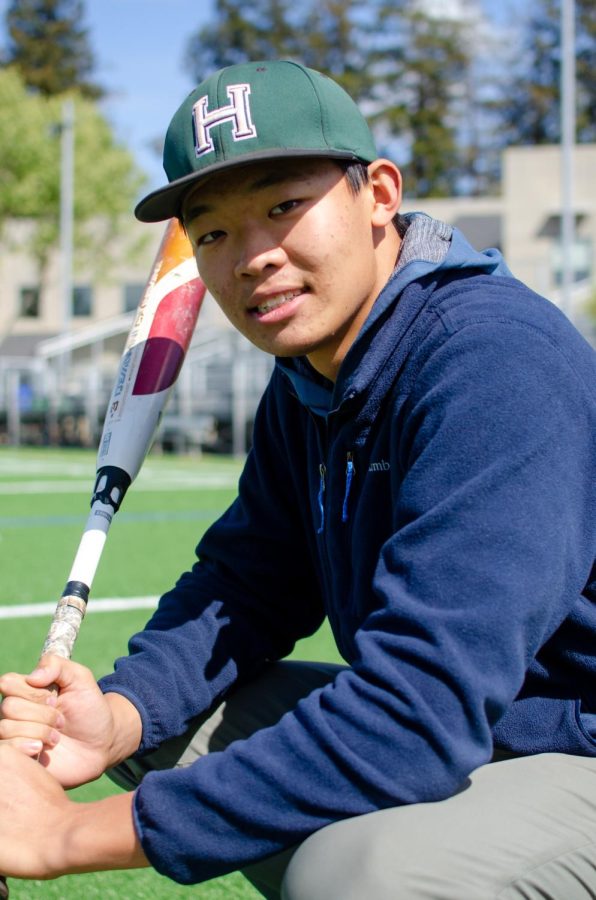

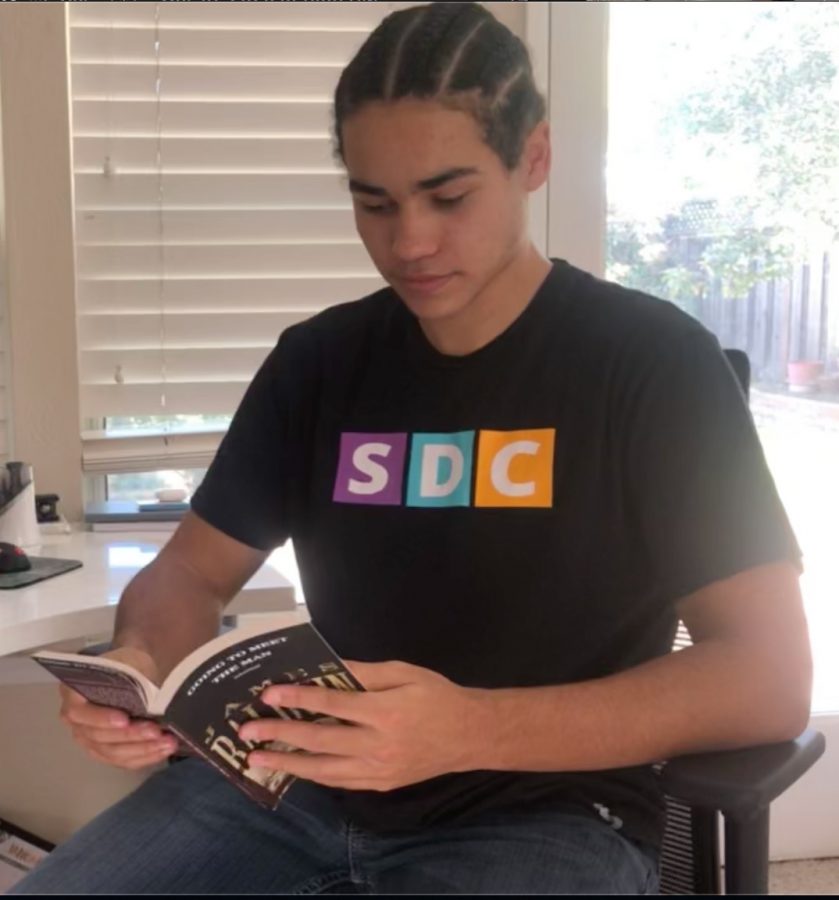
![“When I came into high school, I was ready to be a follower. But DECA was a game changer for me. It helped me overcome my fear of public speaking, and it's played such a major role in who I've become today. To be able to successfully lead a chapter of 150 students, an officer team and be one of the upperclassmen I once really admired is something I'm [really] proud of,” Anvitha Tummala ('21) said.](https://harkeraquila.com/wp-content/uploads/2021/07/Screen-Shot-2021-07-25-at-9.50.05-AM-900x594.png)

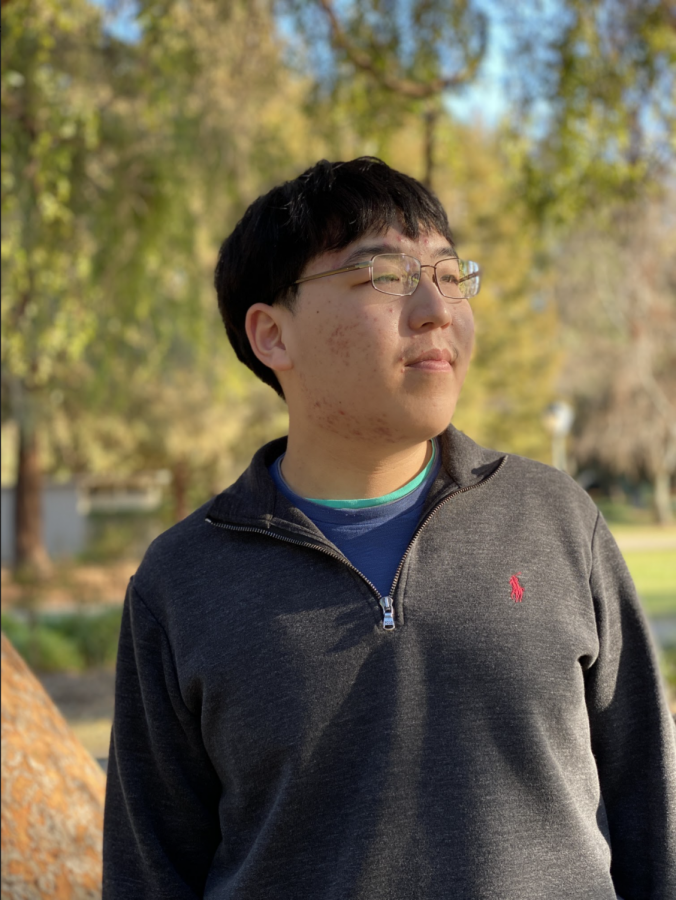





![“I think getting up in the morning and having a sense of purpose [is exciting]. I think without a certain amount of drive, life is kind of obsolete and mundane, and I think having that every single day is what makes each day unique and kind of makes life exciting,” Neymika Jain (12) said.](https://harkeraquila.com/wp-content/uploads/2017/06/Screen-Shot-2017-06-03-at-4.54.16-PM.png)







![“My slogan is ‘slow feet, don’t eat, and I’m hungry.’ You need to run fast to get where you are–you aren't going to get those championships if you aren't fast,” Angel Cervantes (12) said. “I want to do well in school on my tests and in track and win championships for my team. I live by that, [and] I can do that anywhere: in the classroom or on the field.”](https://harkeraquila.com/wp-content/uploads/2018/06/DSC5146-900x601.jpg)
![“[Volleyball has] taught me how to fall correctly, and another thing it taught is that you don’t have to be the best at something to be good at it. If you just hit the ball in a smart way, then it still scores points and you’re good at it. You could be a background player and still make a much bigger impact on the team than you would think,” Anya Gert (’20) said.](https://harkeraquila.com/wp-content/uploads/2020/06/AnnaGert_JinTuan_HoHPhotoEdited-600x900.jpeg)
![“I'm not nearly there yet, but [my confidence has] definitely been getting better since I was pretty shy and timid coming into Harker my freshman year. I know that there's a lot of people that are really confident in what they do, and I really admire them. Everyone's so driven and that has really pushed me to kind of try to find my own place in high school and be more confident,” Alyssa Huang (’20) said.](https://harkeraquila.com/wp-content/uploads/2020/06/AlyssaHuang_EmilyChen_HoHPhoto-900x749.jpeg)



The dark reality of fantasy sports
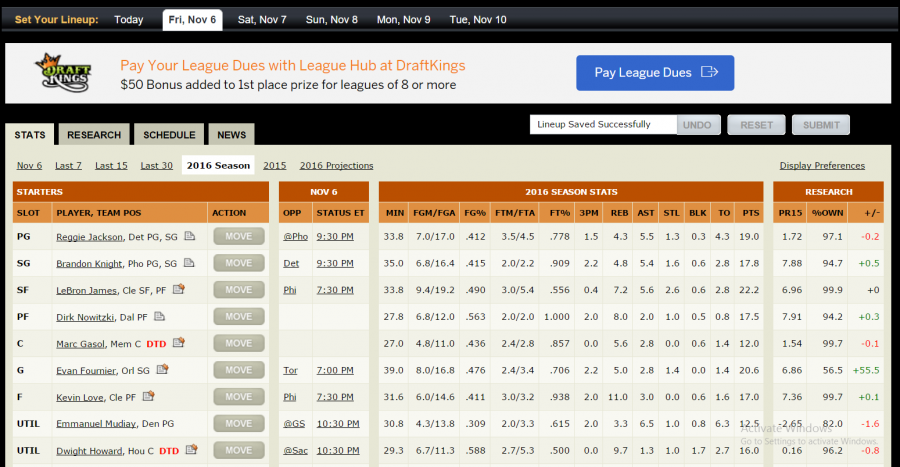
The photo depicts the average fantasy basketball lineup. In fantasy sports, drafting players and setting lineups often involve risking money based on a players’ skills and individual contributions to the fantasy team.
November 6, 2015
As incessant technological advancements continually replace the prevalence of interpersonal communication, they also replace human experience with a virtual reality. Technology, especially in the sports-gaming industry, gives us the opportunity to digitally encounter goals that we may only dream to accomplish: hit a homer in Game 7 of the World Series, hoist the Lombardi trophy in the Super Bowl, drain a game-winning jumper to win the NBA championship.
In a similar sense, fantasy sports, a multi-billion dollar industry, brings contestants to a mock front-office position through drafting top-notch professional athletes and wagering the success of individual teams in daily contests.
While one game could reap great rewards, another game may result in great losses. Fantasy sports, a highly profitable, global enterprise that involves “betting” money on professional sports games, borders illegal gambling.
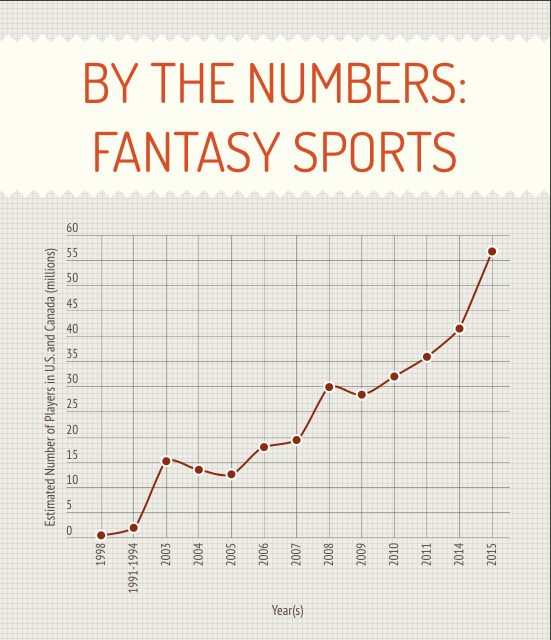
Increased participation rates have led to a tremendous spike in the industry’s commercial activity, as companies set aside a large sum of money purely for advertisements.
For example, FanDuel and DraftKings, two of the most popular fantasy sports companies, have invested $131.4 and $74.5 million, respectively, in TV ads this year as of Oct. 5, 2015, and have collectively produced 19,239 national commercial airings over the past month, according to calculations using iSpot.tv, a site which tracks companies’ television presence. Other sites, such as Yahoo Sports, ESPN, and Draftpot, are formidable competitors as well.
As it is boldly written on their websites, FanDuel promises to dish out “$2 billion in real cash prizes this year” and DraftKings advertises “more than $1 billion guaranteed in 2015.”
Although millions of dollars are exchanged within these companies on a daily basis, most transactions occur without the requisite supervision and regulation. One major loophole exempts this industry from classification as illegal gambling.
Under the Unlawful Internet Gambling Enforcement Act of 2006, “the term ‘bet or wager’ […] does not include […] participation in any fantasy or simulation sports game” because “all winning outcomes reflect the relative knowledge and skill of the participants”.
While assembling a competitive lineup does require some knowledge of the game, factors like athlete health and relative skill of other fantasy opponents certainly fall in the shadow of luck and fortune.
In an interview with Fortune Magazine, FanDuel CEO Nigel Eccles commented on the controversy over the regulation of fantasy sports.
“We’re very similar to, say, a golf tournament or a spelling bee or a horse race,” he said. “There’s an entry fee and if you win it, there’s a prize. It’s not gambling because it’s the skill of an athlete that determines the winner.”
On the other hand, some argue that an easily-accessible and profit-driven outlet like fantasy sports requires at least some regulation.
In the recent Republican Debate, Jeb Bush provided his stance on the issue, proving that the fantasy sports controversy has found national attention.
“Effectively, it is day trading without any regulation at all,” Bush said. “And when you have insider information, […] where people use that information and use big data to try to take advantage of it, there has to be some regulation.”
According to a 2015 survey conducted by Eilers Research, which gathers market data on interactive gaming websites, 70 percent of daily fantasy sports (DFS) participants did not earn a positive return on investment (ROI), or profit.
While some may claim that fantasy sports provides a unique level of excitement and a creative way to view professional sports, others see the industry corrupting society if left unregulated.
The federal government seems to control activities that involve both a large number of participants and high risks for individual and societal health, such as gambling, drugs, alcohol and gun control.
Football game upsets already raise rates of domestic violence in the U.S. Since fantasy sports puts money on the line, domestic violence would reasonably rise if the industry was left to expand unregulated.
Whether or not fantasy sports falls under the definition of “gambling” is a legal matter. Although the government does not need to eradicate the fantasy sports sector or deem it as “immoral,” officials must regulate when the prospects of winning real money permeate and potentially cause social harm.
The adverse attention and effects of fantasy sports probably would not have existed if the business was only a superficial wound on society, but FanDuel, DraftKings, and other companies have now expanded their respective ranges on an international level. If more people join and more money is wagered, unregulated large-scale transactions could potentially lead to drastic societal consequences.
Looking past the numbers and dollar signs, the fantasy sports industry has gained popularity because of its appeal as a unique alternative to just watching sports. “Hiring” some of the best athletes in the world and competing against your friends may seem more interesting than plainly turning on the television and watching a basketball game. Yet, when competition involves an unregulated amount of participants and money, an exciting fantasy may turn into a bleak reality.