

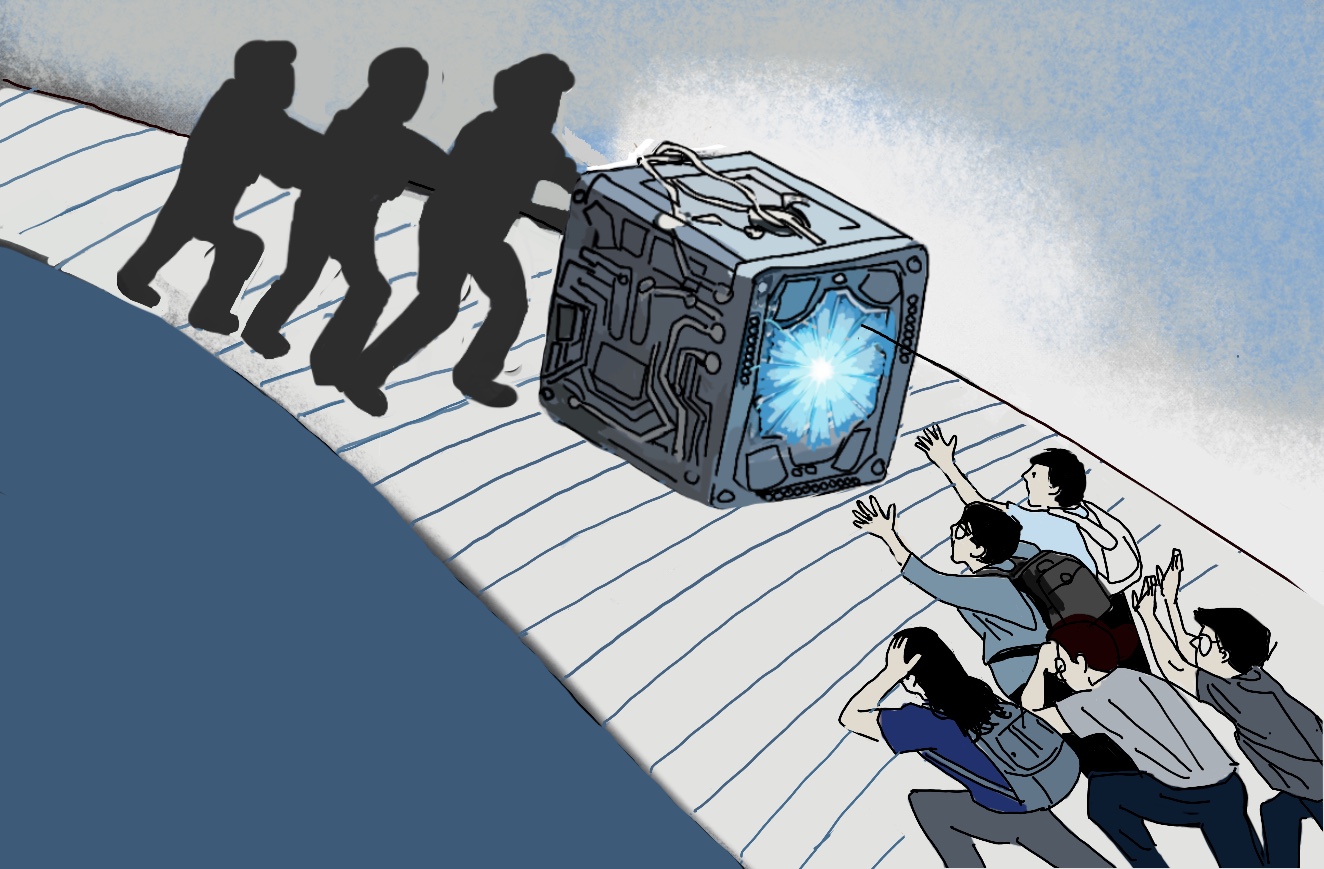
Artificial intelligence traipsed into the classroom without knocking, emboldened with big promises. It could personalize learning. It could boost student engagement and augment efficiency, and, when used well, it could serve as a complement to students’ learning. But have AI educational tools truly fulfilled that purpose? Or are they simply convenient and easily accessible substitutes to learning — in other words, trendy shortcuts?
Teacher and student sessions using Flint, Harker’s AI tool of choice, have increased by 682% at Harker over the past school year, according to Learning, Innovation and Design Director Lisa Diffenderfer. Many teachers have good intentions when bringing AI into assignments, but sometimes the learning gets lost. In some research projects, teachers encourage students to generate AI images or ask AI for sourcing suggestions without clearly connecting to the historical thinking skills they’re supposed to develop.
When assignments become more about learning to prompt an AI tool than mastering material, we must ask if they truly help students learn. AI could be beneficial for students who want to review concepts and spot where they have gaps in their understanding, but that purpose needs to stay in students’ minds.
Many are experimenting with AI tools in real time, and that trial-and-error is natural with new technology. Yet we must also hold the opposite truth simultaneously: that AI has an unfortunate, frequent tendency to be completely wrong. It hallucinates. It makes up answer keys and solves problems using unusual methods, characteristics that aren’t conducive to productive learning. For many students, to whom AI is frequently billed as unreliable, it’s difficult to trust assignments that use AI tools.
Inconsistency among teachers’ rules for students’ AI usage is another issue. While some ban AI for all assignments, others allow it with restrictions, and some even encourage it for certain tasks or test practice.
As for teachers’ own usages, there have been allegations of cases where teachers used AI to generate test questions and answer keys, only later discovering that their exam materials contained errors. Others have used AI tools to mark essays, providing feedback that may look individualized, but in reality, it is generic.
There’s more to cogent writing than the words themselves or the grammatical mechanics of language that AI has mastered with such speed. How can we trust a machine to evaluate real, genuine work — to summarize hours of creative thought in a couple of seconds?
A more coordinated approach in each department would help ensure that AI aids learning fairly. Harker students and teachers have shown a willingness to utilize AI, but we need clearer expectations about how AI can be used in classes, assignments and evaluations. Creating shared guidelines with student input would allow AI to support learning, not just be adopted because it’s an available fad.
Students should also have greater say in how AI is integrated into their education. The upcoming Student-Created AI Activity Showcase is an admirable first step, with clear guidelines and purpose for future AI-supported learning.
Yet, students have no formal way to share their experiences with AI as an educational tool. Creating a space for feedback would allow students to steer the ships of their own learning, moving toward greater dialogue about effective and honest AI use while erasing AI usage misunderstandings between teachers and students.
AI harnesses the potential to transform education. However, we should think about how we use it. We need to pause and assess what’s working and where we can create more structure around AI-related pedagogy.