![“I wasn't discouraged by some of the obstacles we faced. I learned a lot from the leadership. I found that different people need different ways of receiving feedback — you can't [just] tell them to do something and expect the best. [Some] people needed more incentive. A large part of my role was to figure out what worked for everyone and to figure out how to lead all these separate individuals as a team,” Suhana Bhandare (’26) said.](https://harkeraquila.com/wp-content/uploads/2026/06/SuhanaBhandare_JasmineHansra-1-1200x798.jpg)

![“This is actually from Randy Pausch Randy P. Brick: ‘Walls are there for a reason. You have to show how much you want to overcome them.’ You have to show how much you want something. That's what I've always been able to do with tennis, Link Crew and getting that internship [with Kushy Baby]. It’s important pushing through that — getting around that brick wall, climbing over it or clawing through it,” Yash Sachdeva (’26) said.](https://harkeraquila.com/wp-content/uploads/2026/05/YashSachdeva_RamBatchu-copy-1200x1002.jpg)
















![“[Building nerf blasters] became this outlet of creativity for me that hasn't been matched by anything else. The process [of] making a build complete to your desire is such a painstakingly difficult process, but I've had to learn from [the skills needed from] soldering to proper painting. There's so many different options for everything, if you think about it, it exists. The best part is [that] if it doesn't exist, you can build it yourself," Ishaan Parate said.](https://harkeraquila.com/wp-content/uploads/2022/08/DSC_8149-900x604.jpg)



![“When I came into high school, I was ready to be a follower. But DECA was a game changer for me. It helped me overcome my fear of public speaking, and it's played such a major role in who I've become today. To be able to successfully lead a chapter of 150 students, an officer team and be one of the upperclassmen I once really admired is something I'm [really] proud of,” Anvitha Tummala ('21) said.](https://harkeraquila.com/wp-content/uploads/2021/07/Screen-Shot-2021-07-25-at-9.50.05-AM-900x594.png)






![“I think getting up in the morning and having a sense of purpose [is exciting]. I think without a certain amount of drive, life is kind of obsolete and mundane, and I think having that every single day is what makes each day unique and kind of makes life exciting,” Neymika Jain (12) said.](https://harkeraquila.com/wp-content/uploads/2017/06/Screen-Shot-2017-06-03-at-4.54.16-PM.png)






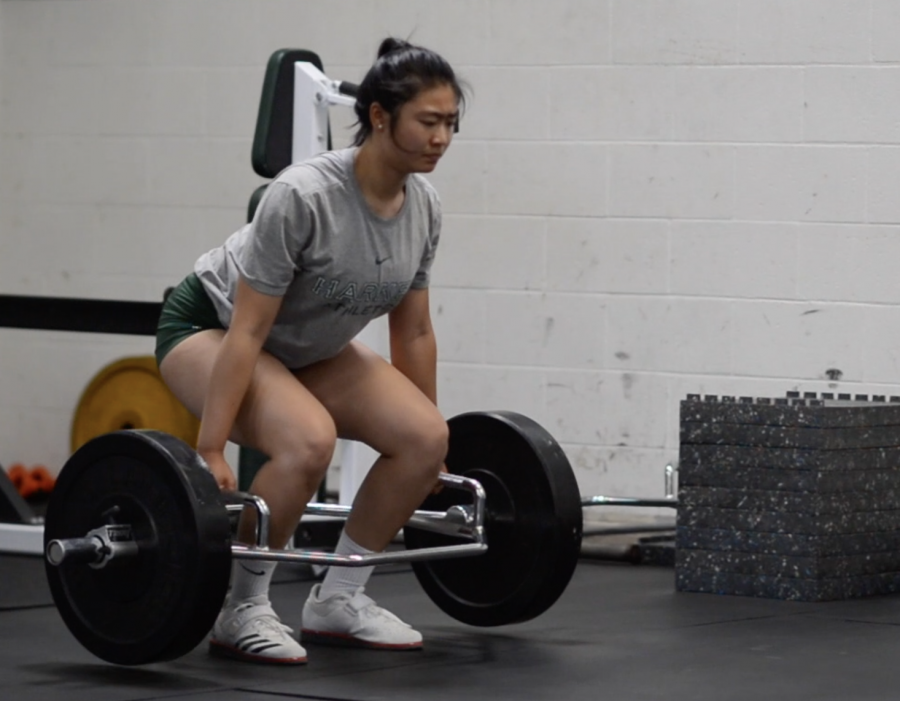

![“My slogan is ‘slow feet, don’t eat, and I’m hungry.’ You need to run fast to get where you are–you aren't going to get those championships if you aren't fast,” Angel Cervantes (12) said. “I want to do well in school on my tests and in track and win championships for my team. I live by that, [and] I can do that anywhere: in the classroom or on the field.”](https://harkeraquila.com/wp-content/uploads/2018/06/DSC5146-900x601.jpg)
![“[Volleyball has] taught me how to fall correctly, and another thing it taught is that you don’t have to be the best at something to be good at it. If you just hit the ball in a smart way, then it still scores points and you’re good at it. You could be a background player and still make a much bigger impact on the team than you would think,” Anya Gert (’20) said.](https://harkeraquila.com/wp-content/uploads/2020/06/AnnaGert_JinTuan_HoHPhotoEdited-600x900.jpeg)

![“I'm not nearly there yet, but [my confidence has] definitely been getting better since I was pretty shy and timid coming into Harker my freshman year. I know that there's a lot of people that are really confident in what they do, and I really admire them. Everyone's so driven and that has really pushed me to kind of try to find my own place in high school and be more confident,” Alyssa Huang (’20) said.](https://harkeraquila.com/wp-content/uploads/2020/06/AlyssaHuang_EmilyChen_HoHPhoto-900x749.jpeg)



When producers announce a film rendition of a classic novel, many readers and moviegoers alike remain skeptical as to whether or not the adaptation will remain faithful to the original work. From the recent movie version of Emily Brontë’s “Wuthering Heights” to the many unique adaptations of Mary Shelley’s “Frankenstein,” readers often diverge in their perceptions of the film.
The transition from book to film poses challenges due to the intrinsic differences between the two forms of storytelling. Classic novels often thrive in introspective spaces, through the inner monologues and detailed descriptions that allow readers to immerse themselves in the plot. While directors attempt to externalize characters’ thoughts and inner dwellings, English teacher Charles Shuttleworth still believes a novel’s philosophical depth gets sacrificed most when adapted.
“If a novel has interior richness, that’s not going to translate,” Shuttleworth said. “One of my favorite novels is ‘White Noise’ by Don DeLillo, and I would not show that film. It just sickens me that they’re taking a novel that’s so thoughtful, philosophical and meaningful about contemporary life and reducing it. They try to make it relevant and lose its real value.”
Classic films can both heighten the storyline of a book or deviate heavily from the original plot, in turn losing the source material’s depth. The 2026 movie adaptation of Emily Brontë’s “Wuthering Heights,” directed by Emerald Fennell, drew negative attention for turning the novel centered on themes of interfamilial tensions, obsession and revenge into an intense romantic film — one repeatedly advertised as the “greatest love story of all time” — released on Valentine’s Day.
Junior Lana Tariq watched the movie adaptation and believes that Fennell stripped the novel of its depth for marketing purposes to appeal to the modern generation.
“Emerald Fennell is a filmmaker who prioritizes shock value over substance,” Lana said. “This was a film that was very in line with this, and the marketing was strategic. The novel ‘Wuthering Heights’ is a romance, and it is intensely psychological and intimate, but not in the way this movie would make you believe. It is just as much about classism and racism as it is about romance.”
In particular, discrepancies between characters as written by authors and how they are portrayed on screen contribute to debate. Fennell cast white actor Jacob Elordi as Heathcliff, a character Brontë depicts as being “dark-skinned,” suggesting mixed-race or Romani origin. History teacher Bronwen Callahan argues that when directors decide to change the appearance of a character, it must be intentional, especially when identity is central to their actions in the novel.
“As someone who very much likes history, one of the theories about ‘Wuthering Heights’ is that the entire point of the book is actually a statement on colonialism,” Callahan said. “When you take the main character and turn him into a white man, you’re changing the entire story. It’s confusing as to why that choice was made — other than the director finds this person more attractive than another. Personally, that’s frustrating.”
The film’s emphasis on love and sex over the novel’s more nuanced themes reflects how classic stories are repackaged for modern audiences. In recent years, romance has even become the fastest-growing segment within fiction. Fennell herself acknowledged that the film was based on her own teenage reading of the book, aiming to capture the romantic feeling of the story rather than creating a faithful adaptation.
“In the publishing industry, there’s a trend towards toxic, intense romances that obviously sells very well,” Lana said. “Fennell’s goal was to make something that would sell the booming audience of ‘BookTok.’ It’s a modern interpretation that’s pretty gutless. Even though it seems risque, it’s just catering to market demand instead of looking at the source material and trying to make something meaningful from it.”
Nonetheless, updating a story’s characters or setting can work in certain situations. Callahan pointed to Baz Luhrmann’s 1996 adaptation of “Romeo & Juliet,” set in a post-modern city named Verona Beach, as a film that changed the original play’s context but was able to preserve Shakespeare’s core message.
“You can update [aspects of the novel] for the modern day and actually have them tell a really great story,” Callahan said. “It can connect to the audience in a certain way if the book is hard to understand, especially if it’s in a time period that you are reading an English class and haven’t necessarily studied yet.”
Shuttleworth and Callahan acknowledged that not every adaptation falls short. Callahan praised adaptations of “The Princess Bride” and “The Exorcist” as films that successfully captured the original author’s intent. Shuttleworth enjoyed the adaptations of Ken Kesey’s “One Flew over the Cuckoo’s Nest” and Kurt Vonnegut’s “Slaughterhouse-Five,” and he screens the latter for his postmodern literature class to help students visualize the novel across different mediums.
Adaptations can serve as different artforms individually, and enjoying both the novel and the film is still possible. In fact, creating renditions of classic novels can often encourage viewers to read the book in their own time or introduce them to works of art they do not typically encounter.
“It’s good to expose a new generation to something great,” Shuttleworth said. “From my generation, it was the movie ‘American Graffiti,’ which was shot in the early 70s, but it was about the 50s, so it was music that I didn’t know. The soundtrack became really popular, and all of a sudden I’m exposed to a whole new generation of songs, which was great.”
Ultimately, the value of adaptation is rarely all-or-nothing. For Shuttleworth, the quality of the film depends entirely on the effort behind it and the nature of the novel itself.
“If it’s a novel that you truly love, the movie version is almost certainly going to disappoint you,” Shuttleworth said. “To expose a modern audience to a great work is a worthy undertaking. It just has to be done the right way.”