![“I wasn't discouraged by some of the obstacles we faced. I learned a lot from the leadership. I found that different people need different ways of receiving feedback — you can't [just] tell them to do something and expect the best. [Some] people needed more incentive. A large part of my role was to figure out what worked for everyone and to figure out how to lead all these separate individuals as a team,” Suhana Bhandare (’26) said.](https://harkeraquila.com/wp-content/uploads/2026/06/SuhanaBhandare_JasmineHansra-1-1200x798.jpg)


![“This is actually from Randy Pausch Randy P. Brick: ‘Walls are there for a reason. You have to show how much you want to overcome them.’ You have to show how much you want something. That's what I've always been able to do with tennis, Link Crew and getting that internship [with Kushy Baby]. It’s important pushing through that — getting around that brick wall, climbing over it or clawing through it,” Yash Sachdeva (’26) said.](https://harkeraquila.com/wp-content/uploads/2026/05/YashSachdeva_RamBatchu-copy-1200x1002.jpg)









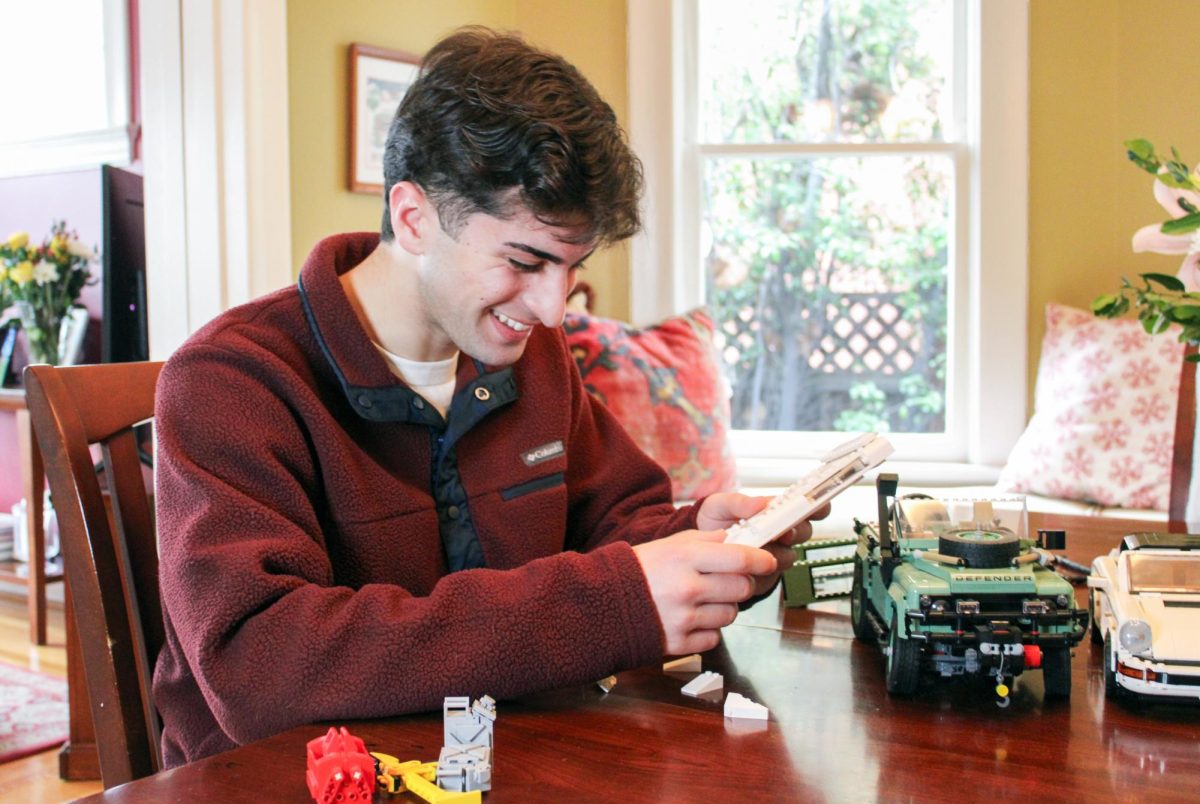








![“[Building nerf blasters] became this outlet of creativity for me that hasn't been matched by anything else. The process [of] making a build complete to your desire is such a painstakingly difficult process, but I've had to learn from [the skills needed from] soldering to proper painting. There's so many different options for everything, if you think about it, it exists. The best part is [that] if it doesn't exist, you can build it yourself," Ishaan Parate said.](https://harkeraquila.com/wp-content/uploads/2022/08/DSC_8149-900x604.jpg)




![“When I came into high school, I was ready to be a follower. But DECA was a game changer for me. It helped me overcome my fear of public speaking, and it's played such a major role in who I've become today. To be able to successfully lead a chapter of 150 students, an officer team and be one of the upperclassmen I once really admired is something I'm [really] proud of,” Anvitha Tummala ('21) said.](https://harkeraquila.com/wp-content/uploads/2021/07/Screen-Shot-2021-07-25-at-9.50.05-AM-900x594.png)







![“I think getting up in the morning and having a sense of purpose [is exciting]. I think without a certain amount of drive, life is kind of obsolete and mundane, and I think having that every single day is what makes each day unique and kind of makes life exciting,” Neymika Jain (12) said.](https://harkeraquila.com/wp-content/uploads/2017/06/Screen-Shot-2017-06-03-at-4.54.16-PM.png)







![“My slogan is ‘slow feet, don’t eat, and I’m hungry.’ You need to run fast to get where you are–you aren't going to get those championships if you aren't fast,” Angel Cervantes (12) said. “I want to do well in school on my tests and in track and win championships for my team. I live by that, [and] I can do that anywhere: in the classroom or on the field.”](https://harkeraquila.com/wp-content/uploads/2018/06/DSC5146-900x601.jpg)
![“[Volleyball has] taught me how to fall correctly, and another thing it taught is that you don’t have to be the best at something to be good at it. If you just hit the ball in a smart way, then it still scores points and you’re good at it. You could be a background player and still make a much bigger impact on the team than you would think,” Anya Gert (’20) said.](https://harkeraquila.com/wp-content/uploads/2020/06/AnnaGert_JinTuan_HoHPhotoEdited-600x900.jpeg)

![“I'm not nearly there yet, but [my confidence has] definitely been getting better since I was pretty shy and timid coming into Harker my freshman year. I know that there's a lot of people that are really confident in what they do, and I really admire them. Everyone's so driven and that has really pushed me to kind of try to find my own place in high school and be more confident,” Alyssa Huang (’20) said.](https://harkeraquila.com/wp-content/uploads/2020/06/AlyssaHuang_EmilyChen_HoHPhoto-900x749.jpeg)



Content warning: This article contains mentions of suicide and depression.

(Katerina Matta)
Botanists often use a glass bell jar to protect samples of delicate plants. These jars serve as vacuums, cutting the samples off from the external world. In Sylvia Plath’s novel “The Bell Jar,” based on her own life, the main character finds herself stewing in the misery of her own metaphorical bell jar.
The novel chronicles 19-year-old Esther Greenwood’s descent into the depths of depression. Esther is intelligent and beautiful, but she finds herself growing apathetic to her life. At her university, she struggles to relate to her classmates and meet a suitable partner. When she returns home from college and finds that she was not selected for a prestigious writing course, she spirals.
I first picked up “The Bell Jar” in 8th grade. However, I soon realized that it was not the type of novel that I could enjoy from a safe distance. Esther’s narration is personal and intimate, and I found myself wondering whether my future might align with hers. I saw myself in her character. As Esther’s depression worsened, I grew more and more uncomfortable. After she attempted suicide, I put the book down.
This summer, I decided to revisit the novel out of curiosity. As with the first time I read it, the writing felt close to me. This time, though, I found that the narrator’s intimacy brought comfort and warmth to the harsh plot. Instead of being overwhelmed by the story, I finally understood its beauty.
Though I enjoyed it, the intensely personal and at times egocentric narrative of the novel is not for everyone. For people who prefer plot driven novels, they may find “The Bell Jar” to be annoyingly self-indulgent. Personally, I liked how deep the book dove into Esther’s frame of mind, and I appreciated the witty narration.
“The Bell Jar”’s main strength is its prose. It may have been written more than 60 years ago, but the writing is light, fresh and lyrical. Plath’s writing is easy to read but maintains its depth, and Esther’s journey throughout the book feels real and relatable.
While most of the book remains relevant today, some scenes are problematic by modern day standards. Esther displays some casual racism in her internal monologue but never faces any consequences for her beliefs. Some argue that the book is a product of its time and provides a portrait of a woman from the past. Still, the bigotry is inexcusable, especially since civil rights movements were on the rise during this time. These throwaway moments do not at all impact the rest of the story, so they could have easily been excluded.
Moreover, Esther is incredibly privileged, which is the reason why she even receives treatment for her depression in the first place. Because Plath, a privileged white woman, wrote her novel by drawing on her own experiences, it has undertones of white feminism, particularly in the moments of bigotry.
Despite these flaws, the book still holds merit. It discusses women’s mental health in a time when it was not widely accepted, and it shines light on unconventional womanhood. Holding Plath accountable for her racism does not mean that her message should be stifled.
The themes of mental health ring true today, as more opportunities for vacuums arise with the internet. I have never struggled with deep depression as Esther does, but I still often find myself falling into vacuums of stress and anxiety. Plath’s writing shows me the light at the end of the tunnel.
“The Bell Jar” is the type of book that cannot be spoiled with a plot summary. Even if the reader goes into the book knowing what happens, the experience of reading is just as breathtakingly raw. Esther’s narration brings comfort and sparks of wit to an incredibly important story. Time and time again, this novel reminds me that I can find my way out of the bell jars I stumble into.
“I took a deep breath and listened to the old brag of my heart. I am, I am, I am.”
Rating: 4.15/5