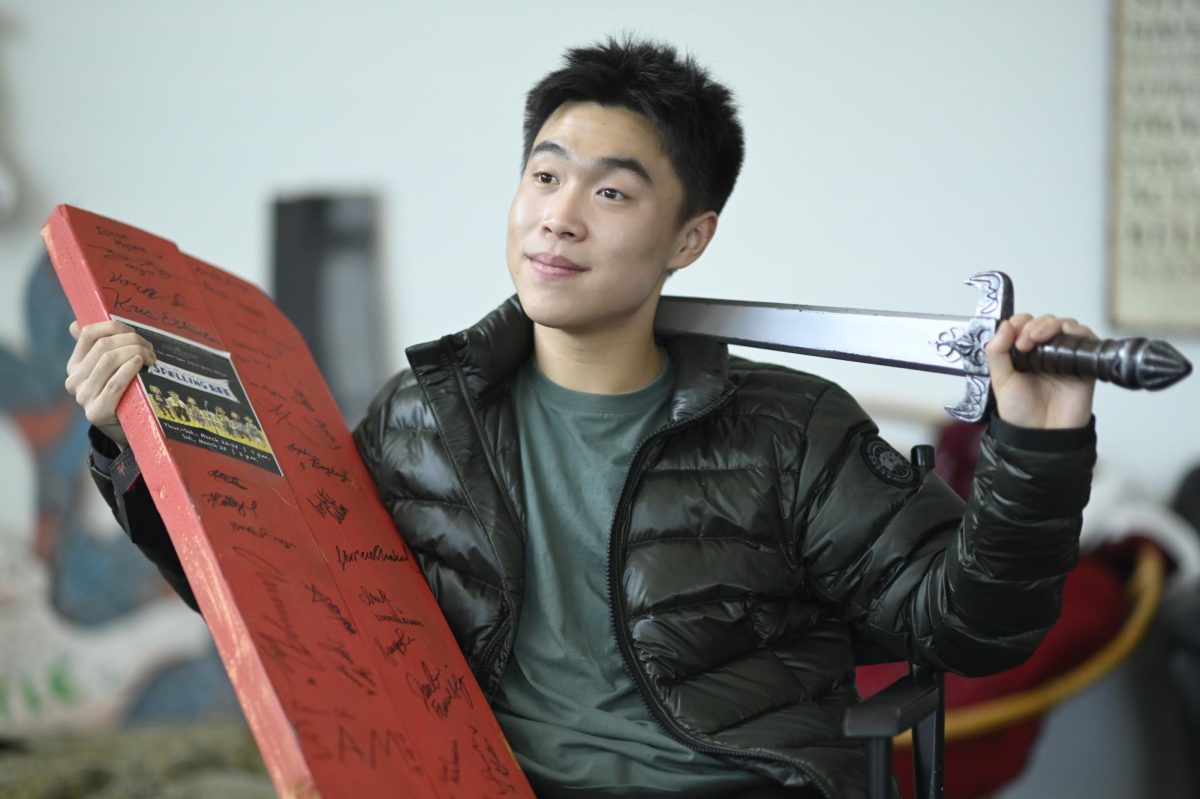
![“I wasn't discouraged by some of the obstacles we faced. I learned a lot from the leadership. I found that different people need different ways of receiving feedback — you can't [just] tell them to do something and expect the best. [Some] people needed more incentive. A large part of my role was to figure out what worked for everyone and to figure out how to lead all these separate individuals as a team,” Suhana Bhandare (’26) said.](https://harkeraquila.com/wp-content/uploads/2026/06/SuhanaBhandare_JasmineHansra-1-1200x798.jpg)


![“This is actually from Randy Pausch Randy P. Brick: ‘Walls are there for a reason. You have to show how much you want to overcome them.’ You have to show how much you want something. That's what I've always been able to do with tennis, Link Crew and getting that internship [with Kushy Baby]. It’s important pushing through that — getting around that brick wall, climbing over it or clawing through it,” Yash Sachdeva (’26) said.](https://harkeraquila.com/wp-content/uploads/2026/05/YashSachdeva_RamBatchu-copy-1200x1002.jpg)








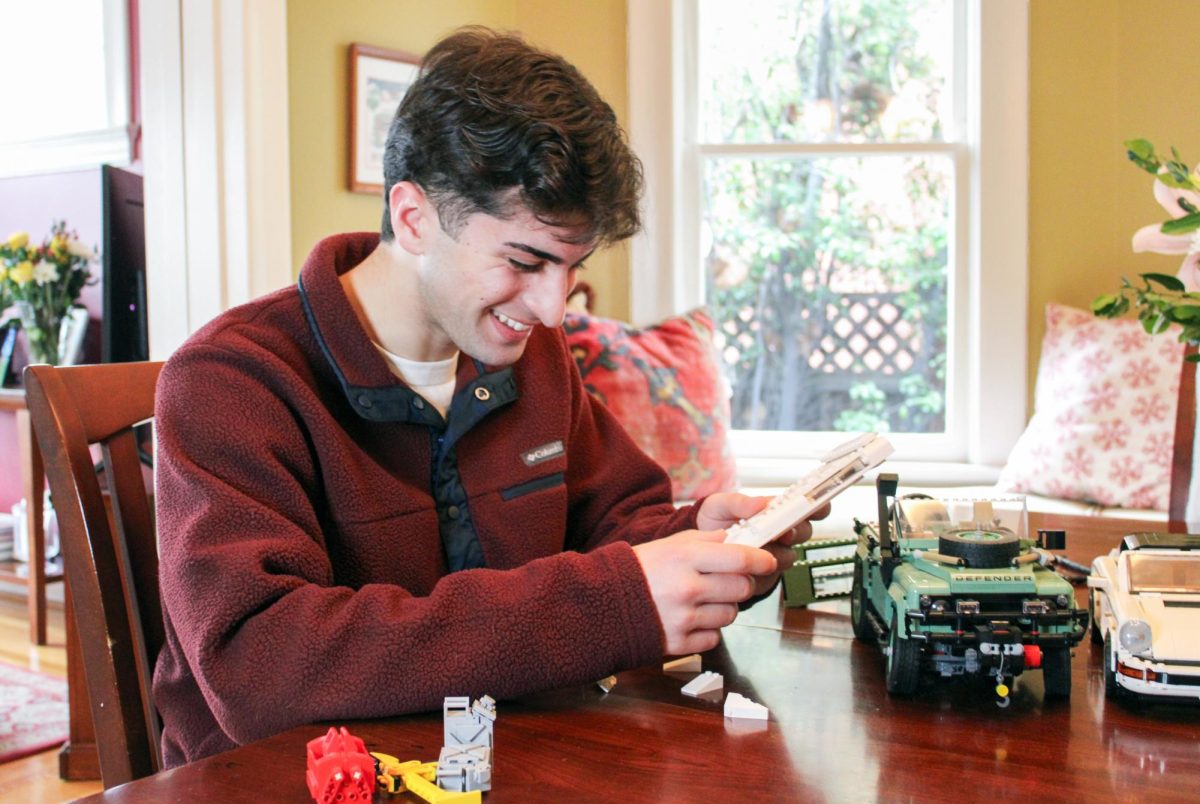







![“[Building nerf blasters] became this outlet of creativity for me that hasn't been matched by anything else. The process [of] making a build complete to your desire is such a painstakingly difficult process, but I've had to learn from [the skills needed from] soldering to proper painting. There's so many different options for everything, if you think about it, it exists. The best part is [that] if it doesn't exist, you can build it yourself," Ishaan Parate said.](https://harkeraquila.com/wp-content/uploads/2022/08/DSC_8149-900x604.jpg)



![“When I came into high school, I was ready to be a follower. But DECA was a game changer for me. It helped me overcome my fear of public speaking, and it's played such a major role in who I've become today. To be able to successfully lead a chapter of 150 students, an officer team and be one of the upperclassmen I once really admired is something I'm [really] proud of,” Anvitha Tummala ('21) said.](https://harkeraquila.com/wp-content/uploads/2021/07/Screen-Shot-2021-07-25-at-9.50.05-AM-900x594.png)






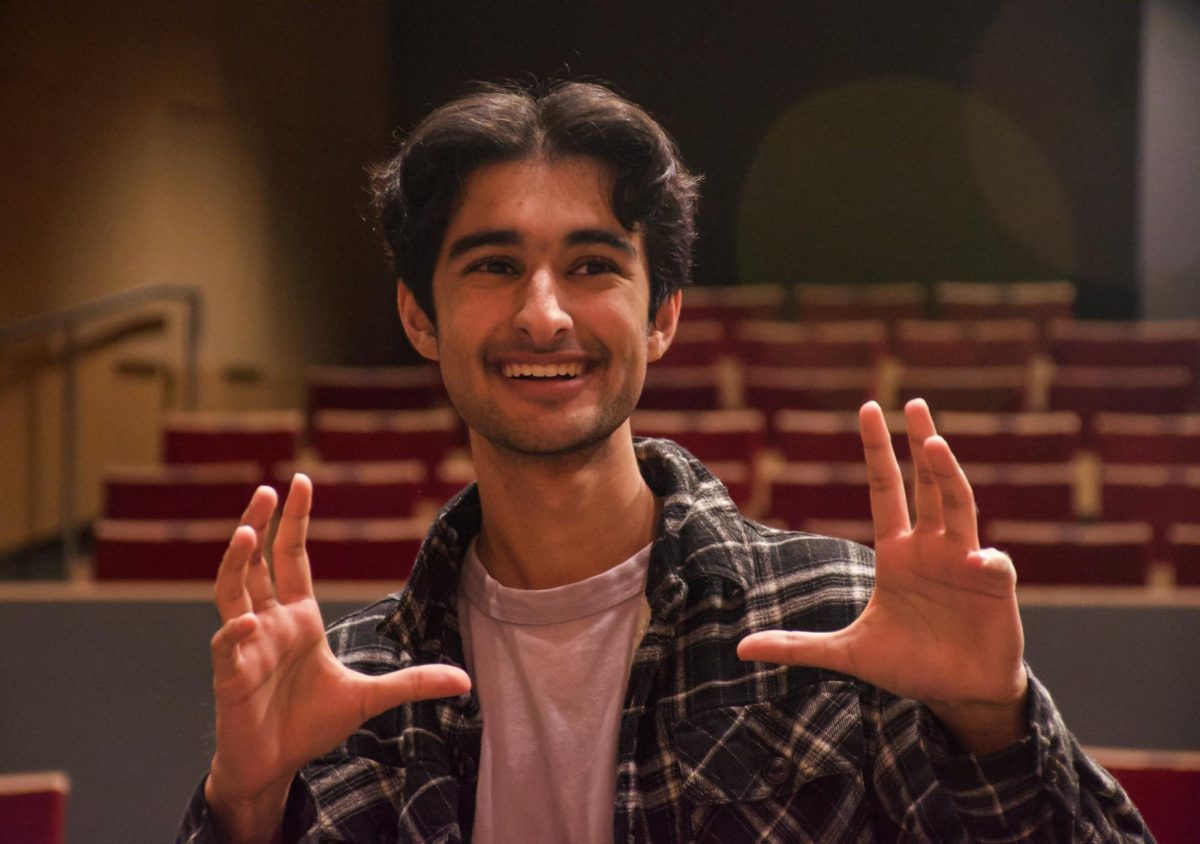
![“I think getting up in the morning and having a sense of purpose [is exciting]. I think without a certain amount of drive, life is kind of obsolete and mundane, and I think having that every single day is what makes each day unique and kind of makes life exciting,” Neymika Jain (12) said.](https://harkeraquila.com/wp-content/uploads/2017/06/Screen-Shot-2017-06-03-at-4.54.16-PM.png)








![“My slogan is ‘slow feet, don’t eat, and I’m hungry.’ You need to run fast to get where you are–you aren't going to get those championships if you aren't fast,” Angel Cervantes (12) said. “I want to do well in school on my tests and in track and win championships for my team. I live by that, [and] I can do that anywhere: in the classroom or on the field.”](https://harkeraquila.com/wp-content/uploads/2018/06/DSC5146-900x601.jpg)
![“[Volleyball has] taught me how to fall correctly, and another thing it taught is that you don’t have to be the best at something to be good at it. If you just hit the ball in a smart way, then it still scores points and you’re good at it. You could be a background player and still make a much bigger impact on the team than you would think,” Anya Gert (’20) said.](https://harkeraquila.com/wp-content/uploads/2020/06/AnnaGert_JinTuan_HoHPhotoEdited-600x900.jpeg)

![“I'm not nearly there yet, but [my confidence has] definitely been getting better since I was pretty shy and timid coming into Harker my freshman year. I know that there's a lot of people that are really confident in what they do, and I really admire them. Everyone's so driven and that has really pushed me to kind of try to find my own place in high school and be more confident,” Alyssa Huang (’20) said.](https://harkeraquila.com/wp-content/uploads/2020/06/AlyssaHuang_EmilyChen_HoHPhoto-900x749.jpeg)


A murder for the sake of literature
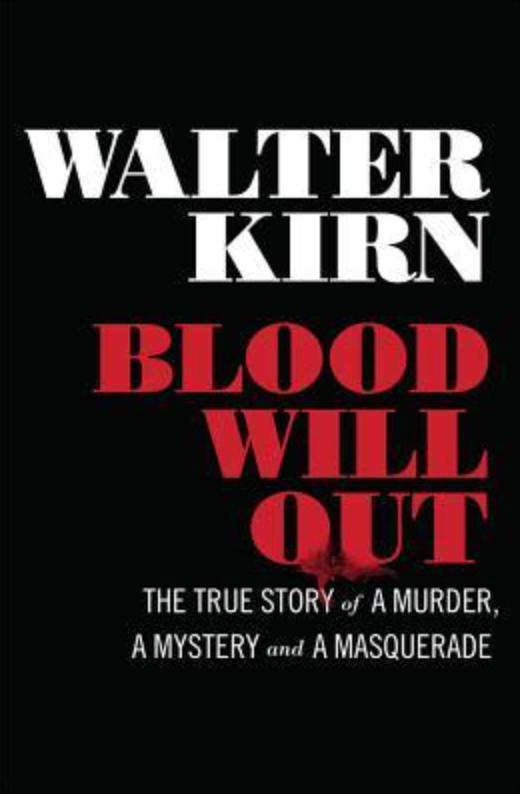
Provided by Goodreads
“Blood Will Out: The True Story of a Murder, a Mystery, and a Masquerade” is a 200 page true crime memoir by Walter Kirn that was first published on March 3, 2014. Kirn is also the author of “Up in the Air,” “Thumbsucker” and “Lost in the Meritocracy.”
April 20, 2021
Aastha’s ranking: ★★★☆☆
From simply grazing my eyes over my bookshelf, I can easily identify red covers and crackled text, the telltale signs of horror novels. My interest in horror novels led me to some casual searching online, where I found “The 25 Best True Crime Books Every Person Should Read.” At first glance, the stark black cover and surreal summary of “Blood Will Out” stood out to me the most.
“Blood Will Out” is the memoir of Walker Kirn, who volunteers to drop off a disabled dog to Clark Rockefeller, a murderer and pathological liar, and the unlikely companionship that blossoms between them for over a decade.
Simply recounting the story, regardless of how bizarre it is, would not be enough to satisfy the reader, and Kirn’s ability to depict himself in an honest, unembellished light comes into play to solve that.
Oftentimes such a portrayal is disturbing; for example, he describes how he wiped urine onto the fur of Shelby, the disabled dog he was assigned to deliver to her new owner’s house, because he was driving, then cried in self-pity.
He doesn’t know the owner yet, who’d later come to be the very murderer, Clark Rockefeller, the story is centered on. Although these instances are disturbing, I found that this made him a more reliable narrator.
Kirn’s transparency is truly recognized in the first 30 pages of the book, when, after reading Steinbeck’s “Travels with Charley,” he reveals an unattractive truth about being involved with writers. They are liars who manipulate their lives and relationships to include those stories in their work, whether it be their own experiences, or if you’re part of their life, yours too.
“A writer is someone who tells you one thing so someday he can tell his readers another thing: what he was thinking but declined to say, or what he would have thought had he been wiser,” Kirn wrote in the novel. “A writer turns his life into material, and if you’re in his life, he uses yours, too.”
Although I trust Kirn’s transparency, this specific passage raises the question of whether Kirn interacts with a murderer simply for the story or whether he truly likes the wealthy and boastful Clark Rockefeller. Furthermore, I believe this passage displays a connection between Rockefeller and Kirn, as they’re both lying to conceal their identities, so the story becomes less focused on Kirn interacting with a murderer and more about how Kirn may be just as underhanded as Rockefeller, which was an interesting spin on the novel.
Contrary to what I expected when opening this book, the plot moves relatively quickly. However, I found it difficult to follow along at times due to the introduction of new characters and scenarios that diverged from the plot, and it often felt like Kirn was only strung along in the friendship due to Clark’s wealth. It didn’t have all the makings of a classic horror novel, but for a memoir, it got pretty close to my standards—I was assuming we’d witness Clark’s despicable nature in action at some point, yet I concur if it got that far, Kirn wouldn’t be here to tell the story.
Beyond my expectations, though, the novel brought a few surprises, namely the awareness of Kirn’s fiction writer career prior to writing “Blood Will Out.” Towards the end of the book, Kirn attends Clark’s trial and reflects on how even he had been fooled by the murderer’s backstory, and he questions how he, a fiction writer, could be duped by the very subject he researches to recreate. This ending ties back to Kirn’s initial dilemma of why he was attracted to Clark, and although it still leaves the question unsolved, I enjoyed Kirn’s self-awareness and how he dives deeper into his uncanny relationship with Clark.
Similarly, does this hint at a link between Kirn, the writer, and Clark, the psychopath? Rather than answer such questions upfront, the book does a fairly good job of leaving behind realizations and inquiries for the reader, and I found myself pondering quite often on Kirn’s true nature and why exactly he chose to pursue Clark.
The read is fit for a high school English class, sans the haunting writing, and it’s shocking when I recognize this is a nonfiction novel because of how unlikely it is for someone to pursue and try to understand the mind of a murderer up close.
While it diverged from my original expectations, the layers of this thick plot reveal some unexpected charms. The book presents Clark as the antagonist, but surprisingly, I found myself questioning Kirn’s character more instead of Clark’s. Though I originally expected a gruesome murder, much to my pleasure, I dove into a complex world of class relations, wealth, and human desires along with human corruption.
I’d recommend this book simply for the character analysis. The plot didn’t stand out to me as much as the main characters, and if the reader enjoys intense, action-packed novels, I’d suggest putting “Blood Will Out” down now. I imagine this story would be accompanied by a dark sky and a comfortable chair, the mellow mood allowing one to absorb the words better. The book is better suited for an adult’s taste, in my opinion, but occasionally there is the odd student that enjoys firsthand glimpses into criminal lives.
For those who enjoyed “Blood Will Out: The True Story of a Murder, a Mystery, and a Masquerade,” Aastha recommends Stephen King’s “Outsider,” Ann Rule’s “The Stranger Beside Me: The Shocking Inside Story of Serial Killer Ted Bundy” and Mark Seal’s “The Man in the Rockefeller Suit: The Astonishing Rise and Spectacular Fall of a Serial Impostor.”