![“I wasn't discouraged by some of the obstacles we faced. I learned a lot from the leadership. I found that different people need different ways of receiving feedback — you can't [just] tell them to do something and expect the best. [Some] people needed more incentive. A large part of my role was to figure out what worked for everyone and to figure out how to lead all these separate individuals as a team,” Suhana Bhandare (’26) said.](https://harkeraquila.com/wp-content/uploads/2026/06/SuhanaBhandare_JasmineHansra-1-1200x798.jpg)


![“This is actually from Randy Pausch Randy P. Brick: ‘Walls are there for a reason. You have to show how much you want to overcome them.’ You have to show how much you want something. That's what I've always been able to do with tennis, Link Crew and getting that internship [with Kushy Baby]. It’s important pushing through that — getting around that brick wall, climbing over it or clawing through it,” Yash Sachdeva (’26) said.](https://harkeraquila.com/wp-content/uploads/2026/05/YashSachdeva_RamBatchu-copy-1200x1002.jpg)


















![“[Building nerf blasters] became this outlet of creativity for me that hasn't been matched by anything else. The process [of] making a build complete to your desire is such a painstakingly difficult process, but I've had to learn from [the skills needed from] soldering to proper painting. There's so many different options for everything, if you think about it, it exists. The best part is [that] if it doesn't exist, you can build it yourself," Ishaan Parate said.](https://harkeraquila.com/wp-content/uploads/2022/08/DSC_8149-900x604.jpg)



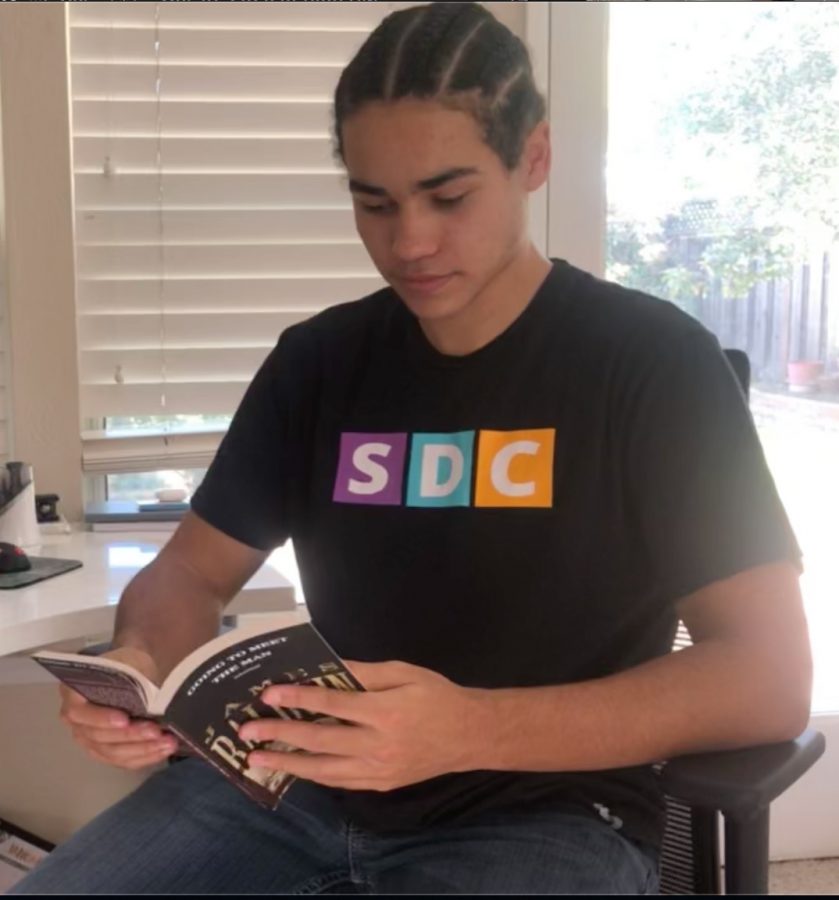
![“When I came into high school, I was ready to be a follower. But DECA was a game changer for me. It helped me overcome my fear of public speaking, and it's played such a major role in who I've become today. To be able to successfully lead a chapter of 150 students, an officer team and be one of the upperclassmen I once really admired is something I'm [really] proud of,” Anvitha Tummala ('21) said.](https://harkeraquila.com/wp-content/uploads/2021/07/Screen-Shot-2021-07-25-at-9.50.05-AM-900x594.png)







![“I think getting up in the morning and having a sense of purpose [is exciting]. I think without a certain amount of drive, life is kind of obsolete and mundane, and I think having that every single day is what makes each day unique and kind of makes life exciting,” Neymika Jain (12) said.](https://harkeraquila.com/wp-content/uploads/2017/06/Screen-Shot-2017-06-03-at-4.54.16-PM.png)








![“My slogan is ‘slow feet, don’t eat, and I’m hungry.’ You need to run fast to get where you are–you aren't going to get those championships if you aren't fast,” Angel Cervantes (12) said. “I want to do well in school on my tests and in track and win championships for my team. I live by that, [and] I can do that anywhere: in the classroom or on the field.”](https://harkeraquila.com/wp-content/uploads/2018/06/DSC5146-900x601.jpg)
![“[Volleyball has] taught me how to fall correctly, and another thing it taught is that you don’t have to be the best at something to be good at it. If you just hit the ball in a smart way, then it still scores points and you’re good at it. You could be a background player and still make a much bigger impact on the team than you would think,” Anya Gert (’20) said.](https://harkeraquila.com/wp-content/uploads/2020/06/AnnaGert_JinTuan_HoHPhotoEdited-600x900.jpeg)

![“I'm not nearly there yet, but [my confidence has] definitely been getting better since I was pretty shy and timid coming into Harker my freshman year. I know that there's a lot of people that are really confident in what they do, and I really admire them. Everyone's so driven and that has really pushed me to kind of try to find my own place in high school and be more confident,” Alyssa Huang (’20) said.](https://harkeraquila.com/wp-content/uploads/2020/06/AlyssaHuang_EmilyChen_HoHPhoto-900x749.jpeg)



Media Matters: Comedic tragedies should avoid the token inclusion of social issues

Three Billboards Outside Ebbing, Missouri walks the line between traditional film genres against the backdrop of social issues relevant in today’s society. The implications of the portrayal of social issues in film should be considered in the context of a movie’s themes and narrative.
January 15, 2018
Martin McDonagh’s black comedy, “Three Billboards Outside Ebbing, Missouri,” is about revenge, but in its 1 hour and 55 minutes runtime, the movie also covers no less than rape, racism in the criminal justice system, the futility of changing offensive vocabulary, homophobia, divorce, police brutality, sexual abuse in Catholic churches, suicide, domestic abuse, depression, sexual abuse overseas by the US military, vigilante justice and abuse of power.
Relevant social commentary and activism have become more prevalent in movies or at least their marketing campaigns, but the facile inclusion of social issues is incompatible with the comedic tragedy genre.
The movie does, by no means, take itself too seriously, juxtaposing laugh out loud moments with nauseating sadness, often in the same scene. Its central message, that “Anger just begets greater Anger,” is thought of by a character who finds the proverb on a bookmark in a book that she believes is about polio, which is really about polo. Not surprisingly, the same character’s baffling stupidity serves as comic relief.
Nearly all movies involve conflict which puts its characters in dilemmas which most people would not want to be in. However, the comedic tragedy rarely resolves the conflict which exists at the beginning of the film. Though characters usually attempt to resolve their problems head on, these attempts usually end in failure or even more suffering. In the end, most characters can only come to accept their situations and find hope and humor in their plights.
In “Three Billboards Outside Ebbing, Missouri,” characters engage in a self-destructive cycle of vengeful violence ending in a moment of hesitation to continue the cycle. In other words, inaction is the best solution for the movie’s character, a dangerous message if applied to real world social problems.
Ultimately, the movie does not address most of the real world problems it brings up. The policeman played by Sam Rockwell who embodies the problems with the America’s criminal justice system achieves redemption through means entirely unrelated to the violence and racism so obviously ingrained in him at the beginning of the film. Other social issues are simply mentioned in passing with no follow-up anywhere else in the movie.
The appeal of a comedic tragedy should come from the catharsis derived from characters finding positivity in bleak scenarios, a feeling not reliant on an audience member relating to the exact scenarios of a movie’s characters or the social issues of the film’s world but rather, to the character’s emotions.