![“I wasn't discouraged by some of the obstacles we faced. I learned a lot from the leadership. I found that different people need different ways of receiving feedback — you can't [just] tell them to do something and expect the best. [Some] people needed more incentive. A large part of my role was to figure out what worked for everyone and to figure out how to lead all these separate individuals as a team,” Suhana Bhandare (’26) said.](https://harkeraquila.com/wp-content/uploads/2026/06/SuhanaBhandare_JasmineHansra-1-1200x798.jpg)


![“This is actually from Randy Pausch Randy P. Brick: ‘Walls are there for a reason. You have to show how much you want to overcome them.’ You have to show how much you want something. That's what I've always been able to do with tennis, Link Crew and getting that internship [with Kushy Baby]. It’s important pushing through that — getting around that brick wall, climbing over it or clawing through it,” Yash Sachdeva (’26) said.](https://harkeraquila.com/wp-content/uploads/2026/05/YashSachdeva_RamBatchu-copy-1200x1002.jpg)


















![“[Building nerf blasters] became this outlet of creativity for me that hasn't been matched by anything else. The process [of] making a build complete to your desire is such a painstakingly difficult process, but I've had to learn from [the skills needed from] soldering to proper painting. There's so many different options for everything, if you think about it, it exists. The best part is [that] if it doesn't exist, you can build it yourself," Ishaan Parate said.](https://harkeraquila.com/wp-content/uploads/2022/08/DSC_8149-900x604.jpg)




![“When I came into high school, I was ready to be a follower. But DECA was a game changer for me. It helped me overcome my fear of public speaking, and it's played such a major role in who I've become today. To be able to successfully lead a chapter of 150 students, an officer team and be one of the upperclassmen I once really admired is something I'm [really] proud of,” Anvitha Tummala ('21) said.](https://harkeraquila.com/wp-content/uploads/2021/07/Screen-Shot-2021-07-25-at-9.50.05-AM-900x594.png)







![“I think getting up in the morning and having a sense of purpose [is exciting]. I think without a certain amount of drive, life is kind of obsolete and mundane, and I think having that every single day is what makes each day unique and kind of makes life exciting,” Neymika Jain (12) said.](https://harkeraquila.com/wp-content/uploads/2017/06/Screen-Shot-2017-06-03-at-4.54.16-PM.png)








![“My slogan is ‘slow feet, don’t eat, and I’m hungry.’ You need to run fast to get where you are–you aren't going to get those championships if you aren't fast,” Angel Cervantes (12) said. “I want to do well in school on my tests and in track and win championships for my team. I live by that, [and] I can do that anywhere: in the classroom or on the field.”](https://harkeraquila.com/wp-content/uploads/2018/06/DSC5146-900x601.jpg)
![“[Volleyball has] taught me how to fall correctly, and another thing it taught is that you don’t have to be the best at something to be good at it. If you just hit the ball in a smart way, then it still scores points and you’re good at it. You could be a background player and still make a much bigger impact on the team than you would think,” Anya Gert (’20) said.](https://harkeraquila.com/wp-content/uploads/2020/06/AnnaGert_JinTuan_HoHPhotoEdited-600x900.jpeg)

![“I'm not nearly there yet, but [my confidence has] definitely been getting better since I was pretty shy and timid coming into Harker my freshman year. I know that there's a lot of people that are really confident in what they do, and I really admire them. Everyone's so driven and that has really pushed me to kind of try to find my own place in high school and be more confident,” Alyssa Huang (’20) said.](https://harkeraquila.com/wp-content/uploads/2020/06/AlyssaHuang_EmilyChen_HoHPhoto-900x749.jpeg)




Global Reset: Escalating Russia-Ukraine conflict takes heavy toll on environment, calls attention to security of clean energy
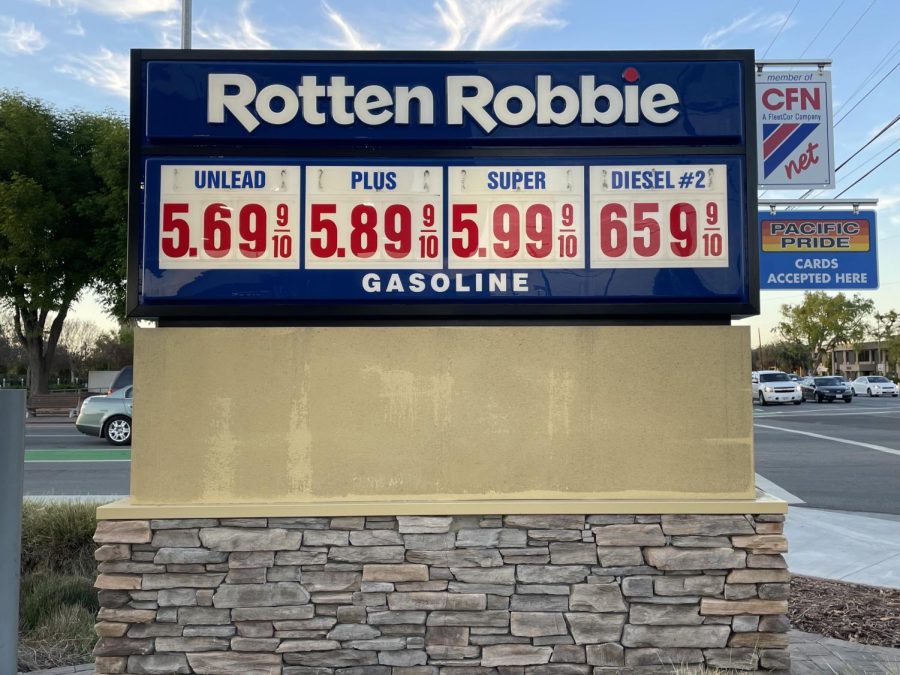
A Rotten Robbie gas station sign displays the increased prices for gas in San Jose, California, on March 25. California’s current average gas price is $5.689 and had a price peak on March 29 at $5.919.
April 25, 2022
The war between Russia and Ukraine poses threats to the environment in both the war zones and in countries with economic ties to Russia as nations scramble to compensate for the lack of Russian materials.
The U.N. continues to warn countries of the impacts of their actions in a time when they suggest that these nations focus on cutting back their usage of fossil fuels. U.N. Secretary-General Antonio Guterres described the utilization of fossil fuels as “mutually assured destruction” at the Sustainability Summit on March 21, since the daily lives of over 3.3 billion people are at risk due to climate change. Green Team Public Relations Head Sriram Bhimaraju (10) also notes the effect on climate change due to weapons manufacturing and usage.
“The mobilization of an army the size of the Russian army takes a whole lot of resources,” Sriram said. “The carbon footprint just in the transportation of resources, and also people to Ukraine, is going to be very large. We also unfortunately have weapons being used that produce smoke, so everything is going to be really bad for the environment.”
Historically, about 80% of the world’s armed conflicts’ battlegrounds landed on biodiversity hotspots, or regions with particularly high amounts of wildlife diversity, in the period from 1950 to 2000. The Ukraine-Russia conflict has deeply harmed southern Ukraine’s Black Sea Biosphere Reserve, home to over 120,000 birds and several endangered species in addition to now containing fires viewable from space due to the spike in military activity. The Russian military has already infiltrated over one-third of Ukraine’s protected natural areas, damaging ecosystems and harming species.
“So many natural resources have been lost,” Research Club Secretary Ella Lan (10) said. “There’s been numerous of these [damaging effects] and people have been focusing on how we can recover from this fire rather than how we can ensure that these fires don’t happen in the first place –– it’s just a change of mentality and change of mindset.”
In addition to water contamination and the harm to the marine world, countries in Europe are rushing to make up for the halted imports of Russian materials such as gas and oil. The U.S. House and Senate stopped these imports in addition to seafood, alcohol and diamonds on April 7 to weaken the Russian economy. The interconnectedness of the world trade system means that any type of conflict or even threat of war can result in significant disruptions in the international economy and especially in the delicate oil industry.
One of Russia’s chief exports, gas, is causing prices across the country to skyrocket. Last year, the U.S. purchased 245 million barrels of Russian oil and 40% of Europe’s gas comes from Russia. In the U.S., gas prices are at an all-time high with the country’s current average at $4.12 per gallon and California at $5.689 with a price peak on March 29 at $5.919. In addition to gasoline, shortages of other petroleum-based products, including plastic, may ensue because of the conflict between Russia and Ukraine.
“We are so dependent upon oil as a natural resource to fuel not just the manufacturing of goods but also the transportation of goods from factory to market,” upper school world history teacher Mark Janda said. “Many of our goods are dependent upon oil and oil byproducts. So when a country that is an agricultural and natural resource powerhouse is invaded by another country, it’s gonna throw oil industries into a tailspin.”
Historical international conflicts have also led to extreme oil crises. For example, in the 1990s, the Iraqi invasion of Kuwait and conflict in the Middle East led to a 33% increase in oil prices for the U.S. Immediately following the attacks of Sept. 11, 2001, oil prices spiked again.
As consumers across the country and world bear the weight of an urgent oil crisis, stock values of clean energy companies and organizations have risen significantly over the past few weeks. Since oil production and importation can slow to dangerously low levels, as shown by the current Ukraine and Russia conflict, people have begun searching for solutions to this reliance on oil products.
“Our dependency on oil is really problematic for long-term peace and safety of people all over the world,” Janda said. “We’ve got to find a way to wean ourselves off of that for the good of everybody, including the climactic issues but also the economic and political issues at play.”