


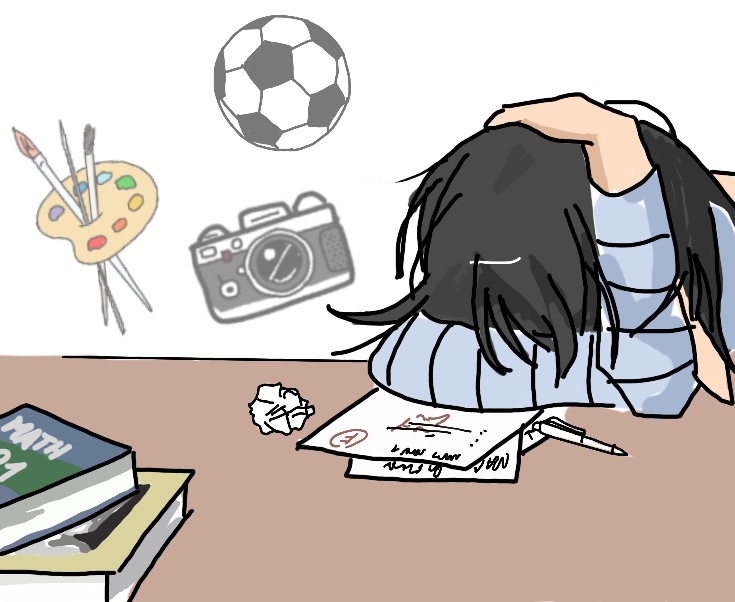
By the time the final bell rings, most students are drained from a day of challenging classes and burdened by a mountain of homework waiting for them at home. A two-hour sports practice or a lunch spent in club meetings often feels too tiring — if not impossible — to add to an already-packed schedule. For many, even activities they are passionate about seem pointless when they lack the time or energy to fully commit.
Academic counselor Kelly Horan frequently meets with students who enjoy their extracurriculars, yet struggle to balance them alongside heavy academic workloads. She describes how many students make the mistake of over committing to activities because they have a wide variety of passions.
“I think our students are genuinely interested in lots of different things,” Horan said. “The other side of that is not knowing how big of a commitment a club might be, so they get caught in this mind of, ‘Lots of things are interesting, so I’m just going to sign up and see what sticks.’”
Sophomore Nikita Jain noticed many of her peers struggling with overcommitment. She recalled signing up for 30 clubs last year but only attending a handful.
“People who aren’t even interested in pursuing a topic in the future will join every single extracurricular,” Nikita said. “Model UN, DECA, mock trial — everything at the same time. It’s just that culture of doing as much as you can.”
Nikita experienced burnout after joining DECA in her freshman year. Though she initially signed up with sincere curiosity about business and found the program enriching for the first few months, the weekly study sessions and long hours leading up to conferences quickly added to the stress of her academic load.
“DECA started feeling like an obligation,” Nikita said. “I realized that I’m not that interested in finance at all; I just can’t see myself doing it. I didn’t want to spend my time doing something that I didn’t enjoy.”
For some students, the issue isn’t disinterest. It’s choosing between many things they care about. Junior Alice Luo participated in cross country, basketball and track her freshman year before directing her focus to track. While she enjoyed sports, the number of commitments left her emotionally drained.
“I was burnt out in the sense that I didn’t enjoy cross country,” Alice said. “I would dread going to practice. For two weeks I got sick and didn’t go to practice, and I had a lot less stress. It wasn’t necessarily about the time commitment, but also not having to go do something I didn’t enjoy.”
Alice ultimately quit cross country, basketball and robotics to prioritize activities she valued more: track, debate and HSLT. After narrowing her commitments, Alice noticed a clear shift in her dedication.
“When I am not able to put in the work or go to do something, I actually feel bad about it,” Alice said. “It’s not like, ‘Oh, I got to skip.’ It’s like, ‘Oh no, I missed something.’ I definitely enjoy those activities more.”
Basketball and cross country athlete Robinson Xiang (12) stopped playing basketball after freshman year. Robinson began the sport before first grade, fell in love with it, and trained intensely through middle school, later becoming the only freshman on varsity. His decision to step away from basketball wasn’t about losing passion for the sport — it was the result of feeling stretched thin by the demands of school, practices and an increasingly packed schedule.
This year, Robinson decided to return to basketball, even though juggling his sports and college applications will make his schedule even tighter.
“I grew up playing basketball, and I miss it,” he said. “I just love the sport. It’s hard doing three sports and college apps, but it’s worth it.”
His experience reflects a similar struggle across campus, where students feel pushed to give up activities they care about. Horan worries that many students drop extracurriculars they love, not because they want to, but because demanding course loads don’t leave time for anything else.
“What gets me is when I hear the kid who says, ‘I love this, but I’m going to quit this year and just study,’” Horan said. “From a neuroscience perspective, that’s not good for your brain. Extracurriculars are often your social time, and as adolescents, that’s one of the most important things to be doing.”
Ultimately, she encourages students to prioritize the activities that energize them and believes that learning to say no is essential for maintaining balance.
“[Students] are dynamic people, and you can’t do everything at once,” Horan said. “Just because you can’t necessarily put time into something now doesn’t mean it won’t be part of your life later — it just means maybe right now, you put it on the back burner.”