



Amidst rigorous classes, extracurricular activities and packed schedules, members of the Harker community have found that side hustles offer a middle ground between work and personal interests. While the typical school day follows a set routine, taking on an independent job provides a self-directed opportunity to build entrepreneurial skills and community relationships outside the campus bubble.
Junior Audrey Hu began exploring nail art during the summer after her sophomore year, eventually turning her intricate, detailed designs into a press-on business run through her Instagram account, “@ahuu.jpg.” She was initially drawn to the medium as an outlet for her creativity.

“I first got into it by seeing a lot of nail art online,” Audrey said. “I always draw very small, even with traditional art, so it was really fun to translate that to a nail art business. It’s something more unique, and you also get to experiment with different mediums.”
Audrey’s nails are higher quality than traditional store-bought varieties. Her sets typically retail between $60 and $70, with each featuring their own unique charms and themes. For her, starting a formal business was a way to carve out dedicated time for her hobby, alongside the benefit of the extra income.
“Part of why I wanted to start a social media account and a business is because I could have separate time for this hobby without feeling like it’s like digging too much into my time,” Audrey said. “I usually like to reserve half of my day on Saturday to work on this. That helps me maintain a good work-life balance between school and my business.”
However, Audrey offers caution for students who may be too wrapped up and pressured to engage in the “hustle culture.”
“A lot of people feel pressured to turn a lot of their hobbies into side hustles nowadays, and I don’t really think that’s necessary,” Audrey said. “It might be better to separate this into an actual retail job and a hobby for fun. But if you find that, like me, it benefits both sides, it might be useful.”
History teacher Mark Janda picked up Uber driving last summer, looking for a way to spend his free time after his two kids left for college. Although he only Uber drives during the summer, the side-hustle has introduced him to a diverse range of passengers around the world.
“I’ve met world-class water polo and track coaches,” Janda said. “I’ve met a man who tried out for the 1984 Olympic gymnastics team. All of these people have such interesting lives because they’ve been all over the world. That’s fun because you’re also forming relationships, and for me in Santa Cruz, it’s getting to know my community even more.”
While many rides are just a fun look into diverse lives, others quickly turn into deeper, unexpected moments of vulnerability. Janda values the profound human connections that he builds with his clients.
“It’s incredible to me how people will get in a car with a total stranger and start sharing really important parts of their lives, and people want that,” Janda said. “People want that sense of connection and community. In that sense, I think it is important. It is giving back a little bit, if you can greet people with a smile, and ask them how their day is going, being kind and a good ear or a good laugh. That’s helping somebody else get through their day.”
While Janda’s side hustle focuses on providing a service and building interpersonal connections, junior Stellan Lindh found his niche by transforming his personal creativity into physical apparel.
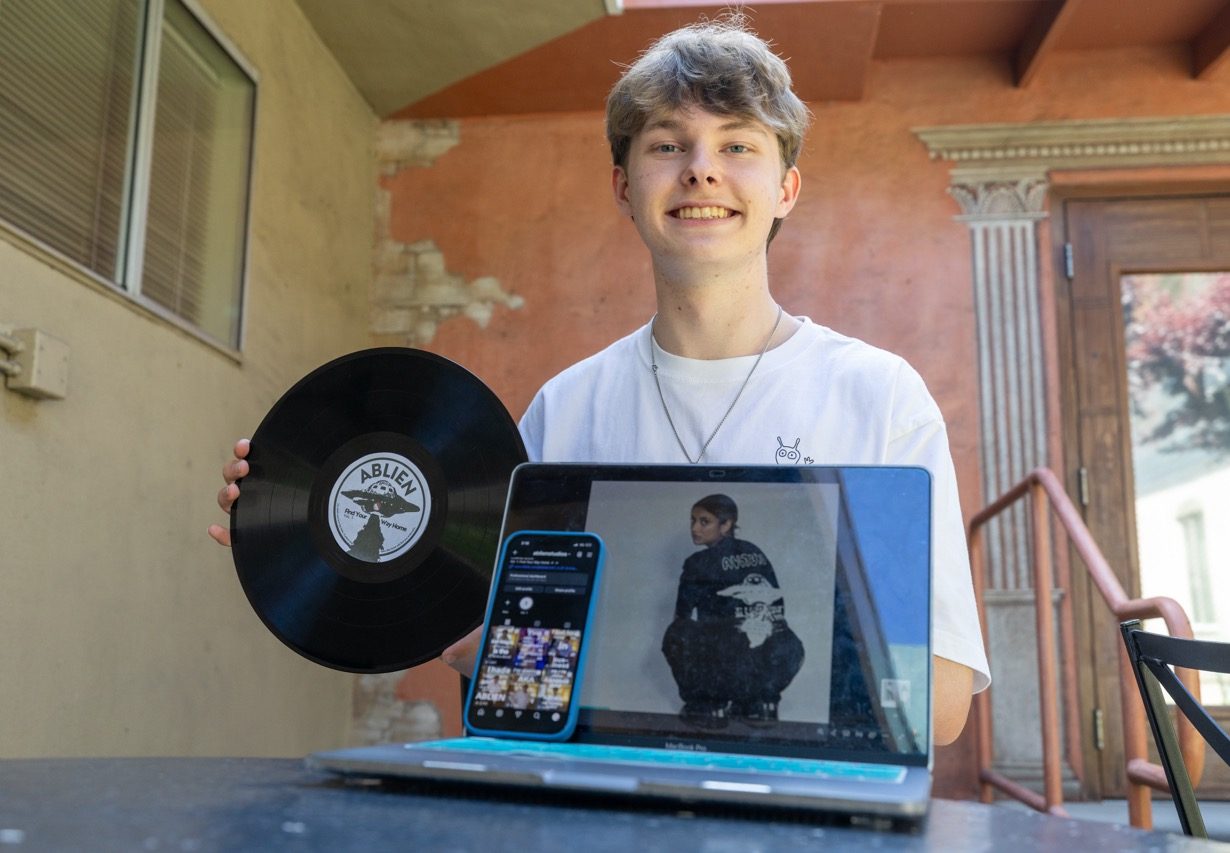
Stellan founded his clothing company Ablien the summer after ninth grade, inspired by a made-up word he used to say to his sister when they were younger. After he made a bag featuring the word as a bold, central graphic in middle school, his mother suggested he turn the idea into something bigger.
The brand’s aesthetic is monochromatic and graphic-heavy, with designs inspired by Stellan’s personal experiences and emotions. He deliberately pushed for a look that would stand apart from what he saw as traditional graphic tees in the market.
“I like really unique graphic details rather than the copy-and-paste graphic t-shirts I saw in different clothing brands,” Stellan said. “I get these design motifs kind of stuck in my head. I see them a lot in the world when I’m thinking about ideas throughout the day. When I have enough ideas, I just sit down and then start sketching different versions of it.”
Releasing his works, though, presented a new set of challenges. Stellan spent nearly a year teaching himself how to screen print. He built wooden frames, stretched mesh and ran UV exposures, but with limited success. Even after purchasing a custom screen, he hit another wall: water-based white ink wouldn’t adhere to black fabric.
The pivot to professional manufacturing brought its own learning curve. Stellan spent a month communicating with a manufacturer, and organized his first photo shoot — all experiences he had only watched others do online, which made building his own business from scratch difficult.
His efforts paid off: of the roughly 40 shirts he originally printed by hand, nearly all of them sold. He has since manufactured 100 more and, without formal promotions, has sold between 25 to 50 of them through word of mouth. Stellan points to the feeling of seeing classmates wearing his designs as his proudest moment so far.
“I’ll see multiple people wearing my clothing, and it’s very validating,” Stellan said. “I’ve had a lot of positive interactions. Some of the people I’ve talked to have bought shirts multiple times from my new collection. It’s super cool to see people buying again, and also, understanding why people want to buy the shirts or want to support is really meaningful.”
Looking ahead, he hopes to build entire creative worlds around each collection, complete with curated playlists in vinyl records and mood boards he created, while maintaining the artistic style that defines the brand. Ultimately, his advice for anybody looking to start their own brand or get into a side hustle is simple: stay authentic.
“The most important thing is just doing stuff that’s authentic to yourself because that’s what people can recognize,” Stellan said. “By being yourself, you attract people who appreciate you, so being authentic just makes having a brand so much easier. So, that’s just doing what you feel like and really trusting your gut.”