



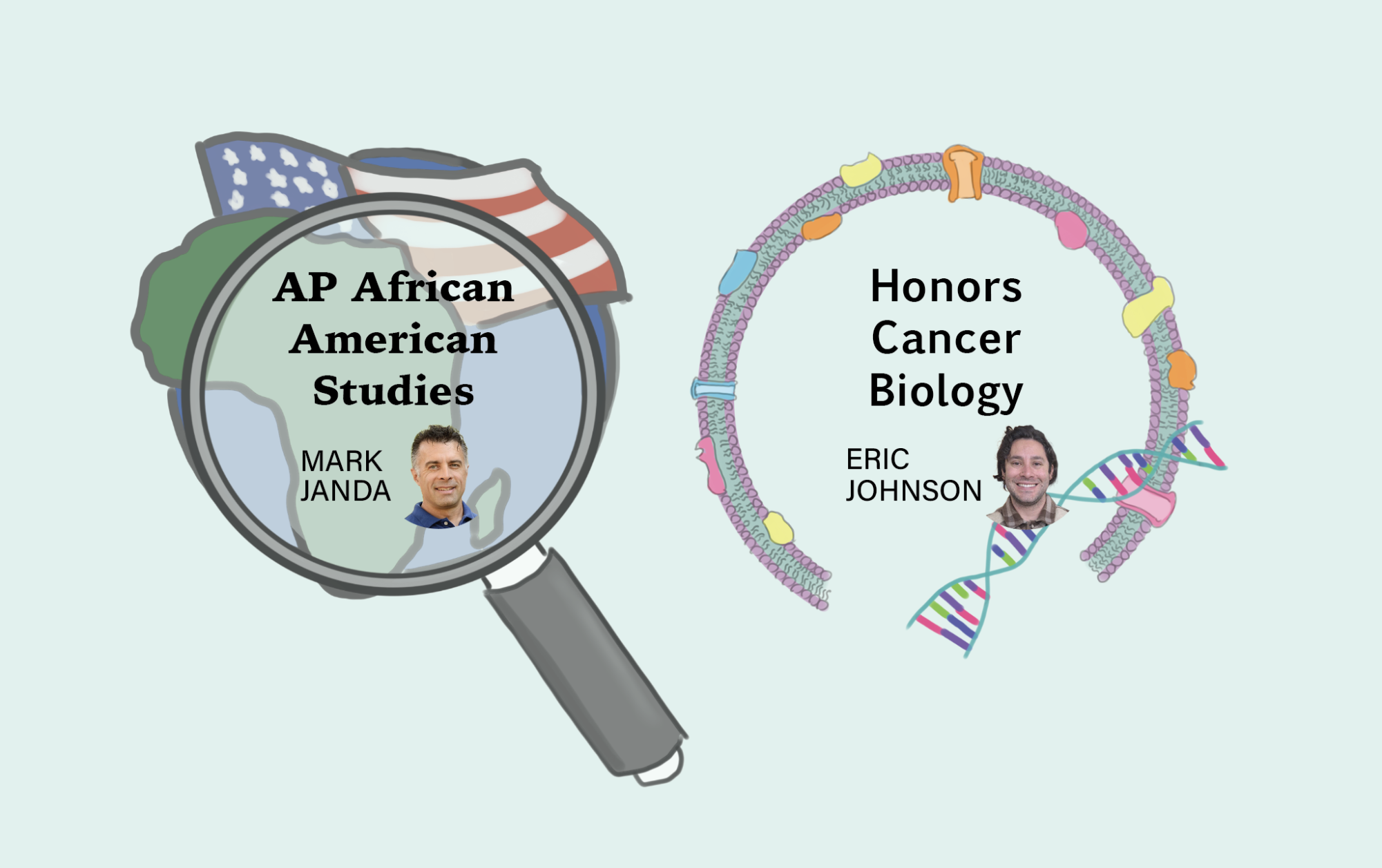
Students will be able to take new courses in the 2026-27 school year: AP African American Studies and Honors Cancer Biology.
The introduction of both courses reflects a broader, faculty-led approach to curriculum development at the upper school. Assistant Division Head Kelly Horan noted that the new offerings typically originate from the teachers themselves, and the ideas are often focused on bringing new academic value and garnering student interest.
“Teachers often come with an idea, and we see if there’s space in our curricular offerings to be able to make that happen,” Horan said. “Because our teaching faculty is finite, we have to make sure any additional classes can be staffed. We constantly look to see if there is a need for new classes or if the ones we currently have are getting a good following from students.”
AP African American Studies, a class first piloted by the College Board in August 2024, will be open to juniors and seniors and taught by history department chair Mark Janda. The course will cover topics including the movement of Africans out of Africa, the history of slavery in the United States, the Harlem Renaissance, the Civil Rights Movement and hip hop, spanning from the ninth century to the present.
“African American history is filled with pain — slavery, Jim Crow, lynching and the denial of rights for nearly the last 400 years — but out of that pain came the blues, jazz, gospel, R&B, soul, rock and hip hop,” Janda said. “We also gained voices and artists such as Langston Hughes, James Baldwin and Augusta Savage, along with many other phenomenal people and cultural movements. To me, that is the inspiration. It is a story of persistence, pride and determination, and that is an essential part of teaching this history.”
Janda previously taught African American history at another high school and helped to develop the Social Justice and Ethnic Studies courses at Harker, which are no longer offered.
Compared to the other AP history courses offered at Harker, like AP European History, AP United States History and AP World History, AP African American History offers an interdisciplinary approach, incorporating literature, music, poetry, politics and law. In addition to the AP exam, students also complete an Individual Student Project, which will be submitted to the College Board as part of their AP score evaluation.
“The content is incredible, inspiring and a lot of fun to teach,” Janda said. “I hope that students gain knowledge of a population that many of them have had little experience with. In college and in life, they will encounter people of ethnicities not widely represented here at Harker.”
In the science department, biology teacher Eric Johnson will teach Honors Cancer Biology, a new advanced elective that examines the development of cancer from cellular mutation to tumor growth to organ failure and metastasis, as well as topics like drug design and public health.
The course will be available to students who have earned an A or higher in one semester of Biology or a B or higher in one semester of Honors Biology or AP Biology. Johnson plans to incorporate case studies in which students analyze clinical data to solve real-world medical problems.
Johnson was inspired by the 2010 nonfiction book “The Emperor of All Maladies: A Biography of Cancer” by oncologist Siddhartha Mukherjee, which chronicles the history of the disease while blending scientific, historical and personal narratives. Johnson emphasized the similarly interdisciplinary nature of the course.
“It’s an incredibly diverse class, even though it has this overarching theme of cancer biology,” Johnson said. “We study history, clinical case studies, public health research, bioinformatics and even elements of public speaking. If students are engaged by the topic of cancer or can relate to it in any way, the course can really resonate with them.”
Beyond expanding academic opportunities, Horan hopes the new courses encourage students to explore disciplines outside of their primary interests. She highlighted the importance of maintaining a well-rounded education.
“For kids who tend to be very STEM focused, having a really wonderful foundation built here in the humanities is so important for being able to problem solve in creative ways when you’re out in the world,” Horan said. “The more I can get you all to take history and English and language and visual arts, all that kind of stuff, the stronger your foundation will be to stand out in disciplines that might lend themselves to AI pretty easily.”