


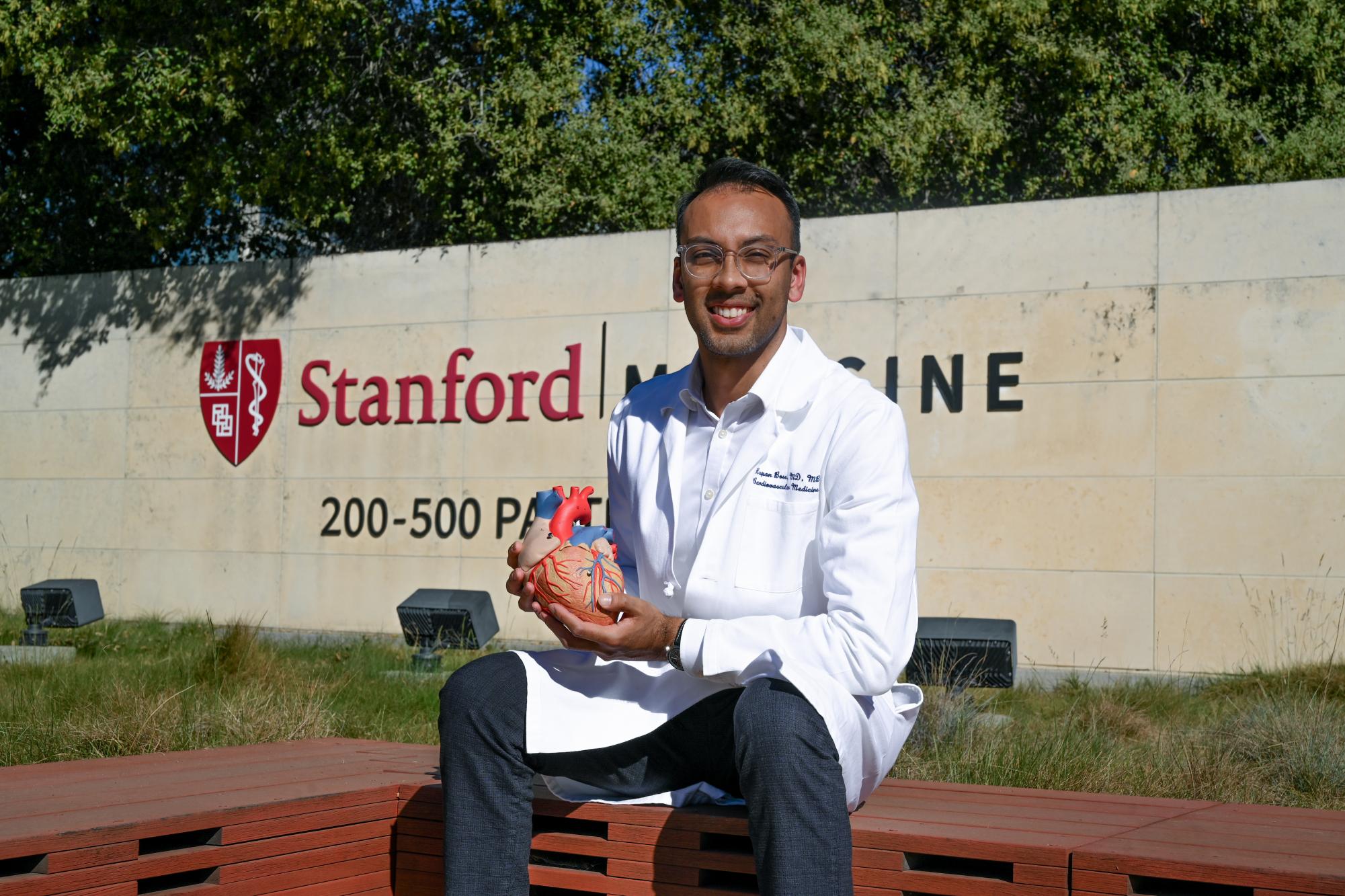
For Dr. Rupan Bose (’07), heart attacks no longer feel inevitable. As a preventive cardiologist and clinical assistant professor at Stanford School of Medicine, he works to reduce the chance they happen in the first place.
Dr. Bose specializes in caring for patients who are at high risk for heart attacks due to past heart complications, genetic disposition, or family history, and helps them avoid heart attacks through early detection and treatment. He chose to enter preventive cardiology because he is South Asian, and his community is are three to five times more likely to suffer from heart problems than the general population.
“I grew up unfortunately seeing a lot of heart attacks, both within my own family as well as in my friends’ families as well,” Bose said. “At the time, there was a thought that heart attacks were something that were inevitable, and that there was nothing that you could do about it, but what we’ve learned over the last 10 to 15 years is that heart attacks are actually preventable.”
Dr. Bose attended the University of Southern California, where he studied neuroscience on the pre-med track. He later pursued a master’s degree in biotechnology and entrepreneurship at the University of Pennsylvania before returning to California to work in digital health at the USC Center for Body Computing, as he had grown up with an interest in tech innovation. Although he moved away from digital health, he still finds that experience valuable and an essential step in his medical career.
“I came back and decided I wanted to go down the pathway of going to medical school and becoming a doctor instead,” Dr. Bose said. “But it’s important to look at healthcare from a much broader perspective, not just the obvious — being a doctor. I would encourage anybody to explore all those different parts of medicine and understand what kind of role they want to take in the future.”
He completed his internal medicine residency at USC as well, and his cardiology fellowship at Harbor–UCLA Medical Center in Los Angeles. In 2024, he joined Stanford’s faculty as a preventive cardiologist and clinical assistant professor.
“The fact that I went into a role that has an education component to it, I really attribute to the teachers that I had back at Harker,” Dr. Bose said. “I had some of the most passionate, excited teachers, and their passion rubbed off on me, to the point now that I am technically an educator at Stanford.”
While at the Harker Upper School, Dr. Bose took STEM classes like biology, chemistry, and physics that formed the beginning of his medical education. At the same time, other classes sharpened the soft skills that would later become central to his career.
“For example, a lot of what I do really comes down to how I communicate with people, how I communicate with patients,” Dr. Bose said. “I’m encouraging them to do things that they may not feel the benefits of today, but are going to hopefully protect them 50, 60 years from now. This communication and persuasion I’ve really learned in my English classes and in debate.”
Dr. Bose also participated in student leadership and served as ASB president in his senior year. As a student leader within a few years of the founding of the high school, he played a formative role in shaping Harker’s spirit culture and contests, according to Spanish teacher Diana Moss, who was his class dean at the time.
“He was actually one of our most memorable leaders,” Moss said. “He truly cared deeply. He led with good humor and grace and had a dignity to him that was unique for his age, from the time he was a freshman all the way to when he was ASB president.”Dr. Bose described how he applies the same initiative and intentionality he gained from high school to his career paths. For example, he landed his position with the USC Center for Body Computing by meeting with cardiologist Dr. Leslie Saxon after viewing her TED talk on digital healthcare.
“I was once told that luck is the intersection of opportunity and preparedness, and both of these are not passive but active things that you do,” Bose said. “You go out there and you create opportunities, and you get prepared to take advantage of them. I attribute every opportunity and role that I’ve ever had to this concept: make luck yours.”