



Before the morning bell rings and lines of cars begin to weave down Saratoga Avenue, College Counselor Martin Walsh has already been on the move for nearly two hours.
Walsh’s multi-modal commute begins 40 miles away in San Francisco, where he bikes to the San Francisco Caltrain station. After 50 minutes on the train, he steps off at the Santa Clara station. From there, he begins the final five-mile stretch to Harker, pedaling through the grounds of Santa Clara University as he makes his way to campus for an 8:30 a.m. arrival.
“I can actually get a lot of work done in that one hour, so I found that the train was really efficient,” Walsh said. “Coupled with the biking part, that allowed me to get in some cardiovascular exercise before school started. My students joked that when I did bike they could tell that I was in a really good mood because I felt energized all day.”
During his 19 years at the school, Walsh has avoided a purely car-dependent commute, finding it useful in improving both his productivity and physical well-being. While most of the Harker community navigates to and from campus by car, for some, forging their own routes through walking or public transportation offers beneficial alternatives.
Junior Lana Tariq, who lives in Pleasanton, relies on the Altamont Corridor Express to commute home each day. While her father drives her to school in the mornings, her afternoon journey requires a short walk off campus, an Uber to the Santa Clara Station and an hour-long train ride, before her parents pick her up from the station to take her home. In total, she’s on the road for just under two hours — yet she prefers this to sitting through rush hour traffic.
“It is kind of taxing, but it’s just about adapting and getting used to it,” Lana said. “I live far, so with traffic leaving at 3 p.m., I would get home at 4:30 p.m. anyways, maybe even 5 p.m. A car is a lot worse than a train because there’s no legroom. You can’t really work. Even though it’s a bit more steps, it actually gets me home quicker, and it’s more comfortable.”
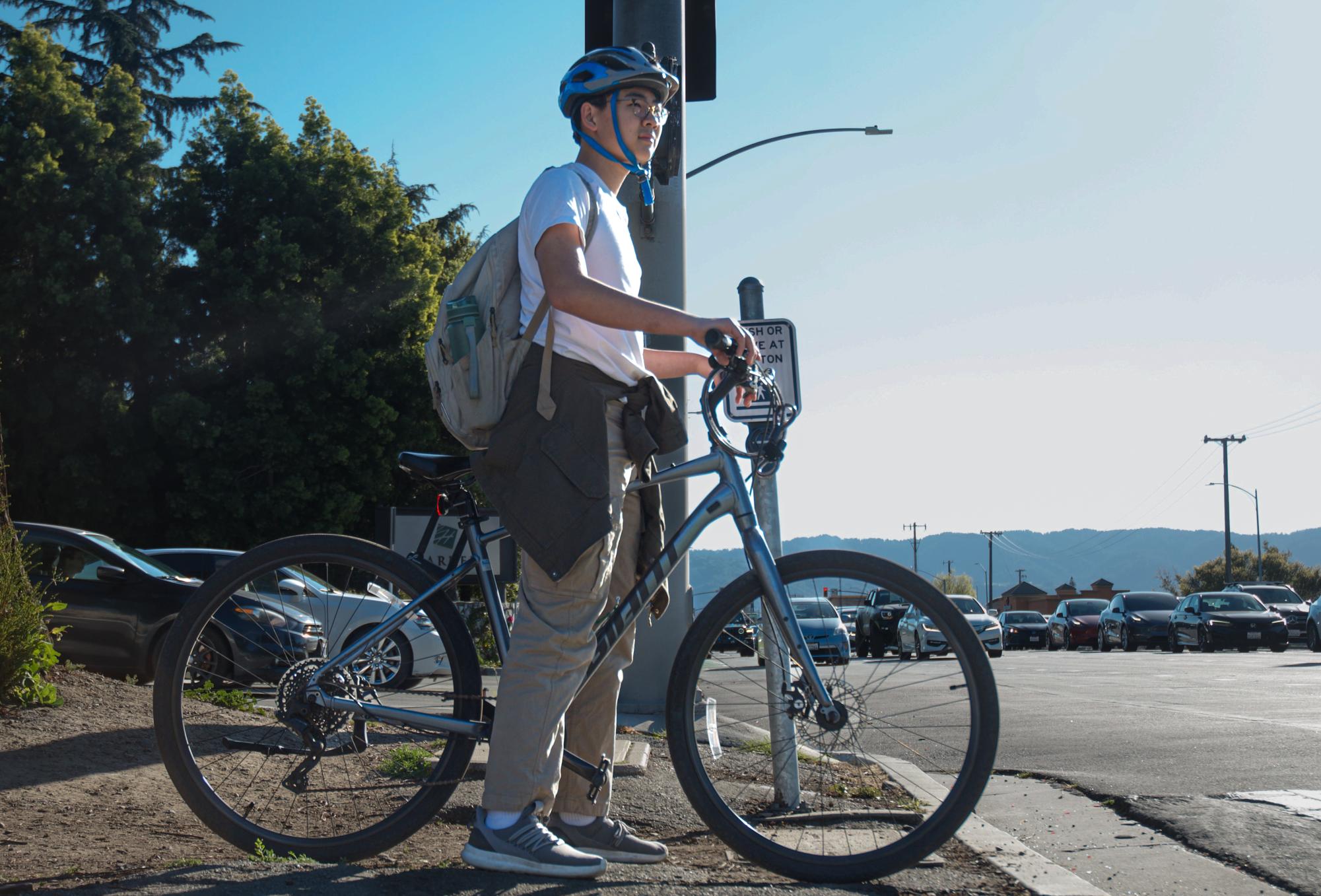
Students who live closer to campus can also reap the benefits of a more active commute. Biking five to ten minutes to school each day, sophomore Bryan Ma has gained greater autonomy even without obtaining a driver’s license.
“I can come and go whenever I want,” Bryan said. “If I need to grab something from home after school, I can just go back, so that’s really convenient. I get more freedom because no one’s waiting on me to leave school early, and I can stay for however long or short I want to. You get to build a sense of independence, where you’re not relying on other people, and people aren’t relying on you.”
Bryan’s biking also stems from another consideration: his parents have to drive his brother to a different school. With children commuting to different campuses often leading to timing conflicts or heavy traffic, some families take more creative routes.
Though siblings Madeline Pham (9) and Ryan Pham (11) do not completely rely on a car-free transport, their ride to school ends at the Applebee’s on Saratoga Avenue and requires a brisk walk across the Interstate 280 intersection before arriving on campus.
“We also need to drop off our little brother in the morning who goes to school 20 minutes in the wrong direction,” Madeline said. “My parents try not to go too far into the lights that are nearby Harker because those usually get them really stuck. Also, just going through the loop to get dropped off at school itself takes a really long time too, so it’s usually easier to just go across.”
While these alternative modes of transportation offer numerous benefits to students, staff and families alike, they also bring their own challenges. Bryan noted how seasonal changes interfere with his motivation to hop on his bike each day.
“It’s really cold in the morning in the winters,” Bryan said. “I often have to wear two jackets — I have one that I’ll wear under and then a super thick jacket — and I also need gloves because my hands freeze. It’s also admittedly sometimes annoying because it takes a lot of effort, and I would sometimes rather be in a car and just take a nap.”
Winter’s shorter days and the onset of daylight saving time can also make evening commutes unsafe for students. While the majority of Lana’s route takes place by train, she highlighted her unease over standing outside of the campus gates to wait for an Uber after sunset.
“It can be kind of exhausting to walk out, get an Uber and go,” Lana said. “Especially in winter when it gets dark, I really hate it. That’s why in winter I try not to stay at school after 5 because I don’t like being there in the dark.”
As students weigh convenience and safety, staff members navigating family responsibilities confront a different set of trade-offs. For Walsh, who has a four-year-old son at home, the rigid train timetable eventually became too difficult to balance with family obligations and has temporarily shifted him toward driving his electric vehicle.
“Working a little bit late here might mean that I miss the train, and then the next train’s down for 40 minutes,” Walsh said. “It’s the difference between getting home in time to have dinner with my son versus getting home and my son’s already asleep. So taking the train for me, the downside is that you’re a prisoner to that train’s schedule.”
Yet Walsh, Lana, Bryan and Madeline found that the advantages of a non-car-centered commute outweigh these concerns. For Lana, relying on public transportation has allowed her to develop not only independence but also interpersonal skills, which she carries with her long after she exits at her stop.
“It’s actually taught me that I am an approachable person,” Lana said. “I get approached a lot and asked, ‘Is this the train coming here?’ It’s just about being sociable and being open and able to talk to people. If someone asks me a question, I’m always going to talk to them and check in if they don’t know where to go. A train isn’t a place where people are crazy — most of the time it’s just people getting home from work and minding their business.”