



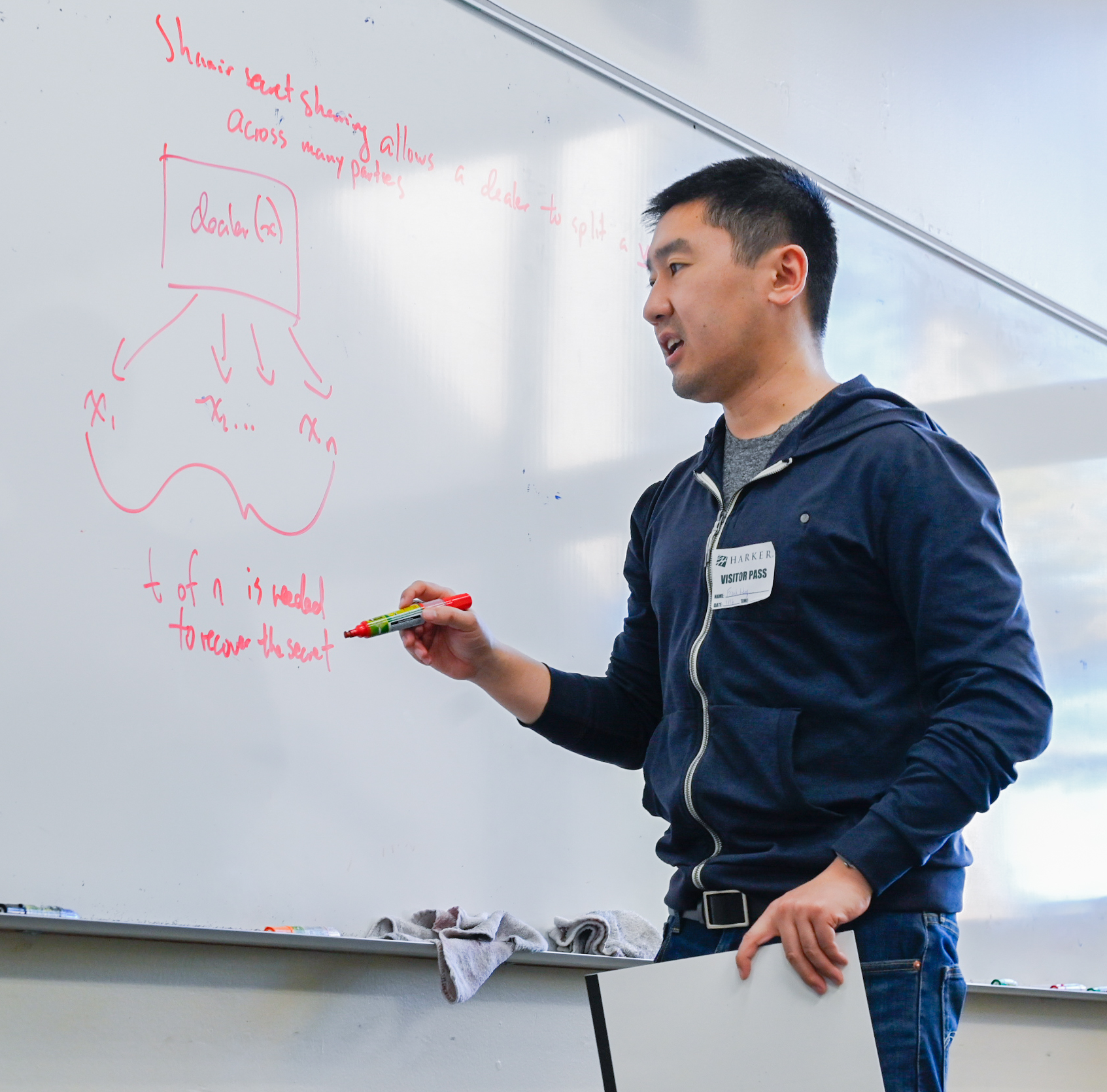
When tech startups expand, they need a dedicated engineer to ensure the resilience of their cybersecurity infrastructure. Frank Wang (‘08), Ph.D., is that person. He serves as a security engineer for Surge AI, where he takes on assorted roles from writing software to ensuring compliance with legal regulations and managing employee access.
However, Wang didn’t zero in on security right away: His interest in the field evolved during his undergraduate years at Stanford University, where he took classes in a variety of subjects like sociology and writing but ultimately chose to study computer science and engineering systems.
“I wanted to do something that had a mixture of math and a systems application,” Wang said. “There were two options back then: AI, which was not anywhere close to [the current boom], and then there was security.”
He started to explore cybersecurity research, specifically in data privacy, during his junior year of college. One of his projects investigated how cryptography could allow social media users to access a “Nearby Friends” feature without exposing their exact locations. Another examined how to encrypt sensitive healthcare data in compliance with the law.
“Not a lot of people were interested in privacy in 2012,” Wang said. “Even my advisor thought that no one really cared. But that’s the point. If you believe in something important to you, you need to dig deep and figure out if it’s actually interesting without listening to whether other people believe in it.”
Even though his academic interests did not necessarily align with the popular fields of his day, he stuck with his dedication to security. The field had access to funding and opportunities but few active researchers.
“Security was something people didn’t want to do, but then it became interesting over time,” Wang said. “It became a bigger topic around 2014 with a lot of Fortune 500 hacks on the news. From there, I just never looked back.”
Wang’s curiosity ultimately led him from Stanford to MIT, where he continued his research and worked towards earning his Ph.D.. He finds that his degree was worth the intensive study and years-long dedication.
“There’s something about writing a thesis and [being] forced to justify yourself on new research that’s quite interesting,” Dr. Wang said. “People who don’t have a PhD don’t believe PhDs are worth it, but if you ask everyone who has a Ph.D if they would do it again, a lot of people would say yes.”
After completing his Ph.D., Wang stepped away from research and entered venture capital, hoping to explore the startup world he had grown up around in the Bay Area. While working on a security incubator, he received the opportunity to join a venture capital firm.
“When you’re in college, there’s a lot of activities to do,” Wang said. “I [had] wanted to do more during my Ph.D., so I thought, ‘This is kind of a unique opportunity, let me try it.’ Then, a year and a half became three and a half years.”
Despite the detour into finance, the pull of cybersecurity brought him back to the tech world. Wang joined a series of startups as their first security hires. He brought his expertise to data infrastructure firm dbt Labs and mental healthcare system Headway before entering his current role at Surge AI.
“I always thought the startups were more interesting because things move faster [and] you can try a lot of things,” Wang said. “[The environment] was actually similar to my Ph.D., which was a small group of people working on a bunch of things. At big tech companies, you don’t do as much or learn as much as you would like, so that’s why I ended up going to a startup.”
Wang did not follow a conventional career path. He tends to pursue his interests rather than titles — in fact, he has never received a traditional promotion.“You should listen to other people for [career] advice, but you shouldn’t always follow it,” Wang said. “Careers are not linear, and you usually find the most unique work in a nonlinear manner. People will perceive it in different ways, but that’s not what matters.”