


Puerto Rican superstar Bad Bunny won “Album of the Year” and four other trophies at the Latin Grammys on Nov. 13 for his latest album “DeBÍ TiRaR MáS FOToS”. He held the record for most-streamed artist on Spotify for three consecutive years. Nonetheless, the NFL’s decision to select Bad Bunny as the headline performer for the 2026 Super Bowl LX Halftime Show provoked a divided reaction.
For many fans, the announcement created a moment of celebration and pride.
“I was very excited when I heard about it. He’s popular in the mainland, in the Latino community we have in the U.S.,” Bad Bunny fan Jessie Valdivia (10) said. “It’s fair for us to have somebody that would represent us. Even though football is very American, it’s a good opportunity to expose him to the whole country and enjoy his music.”
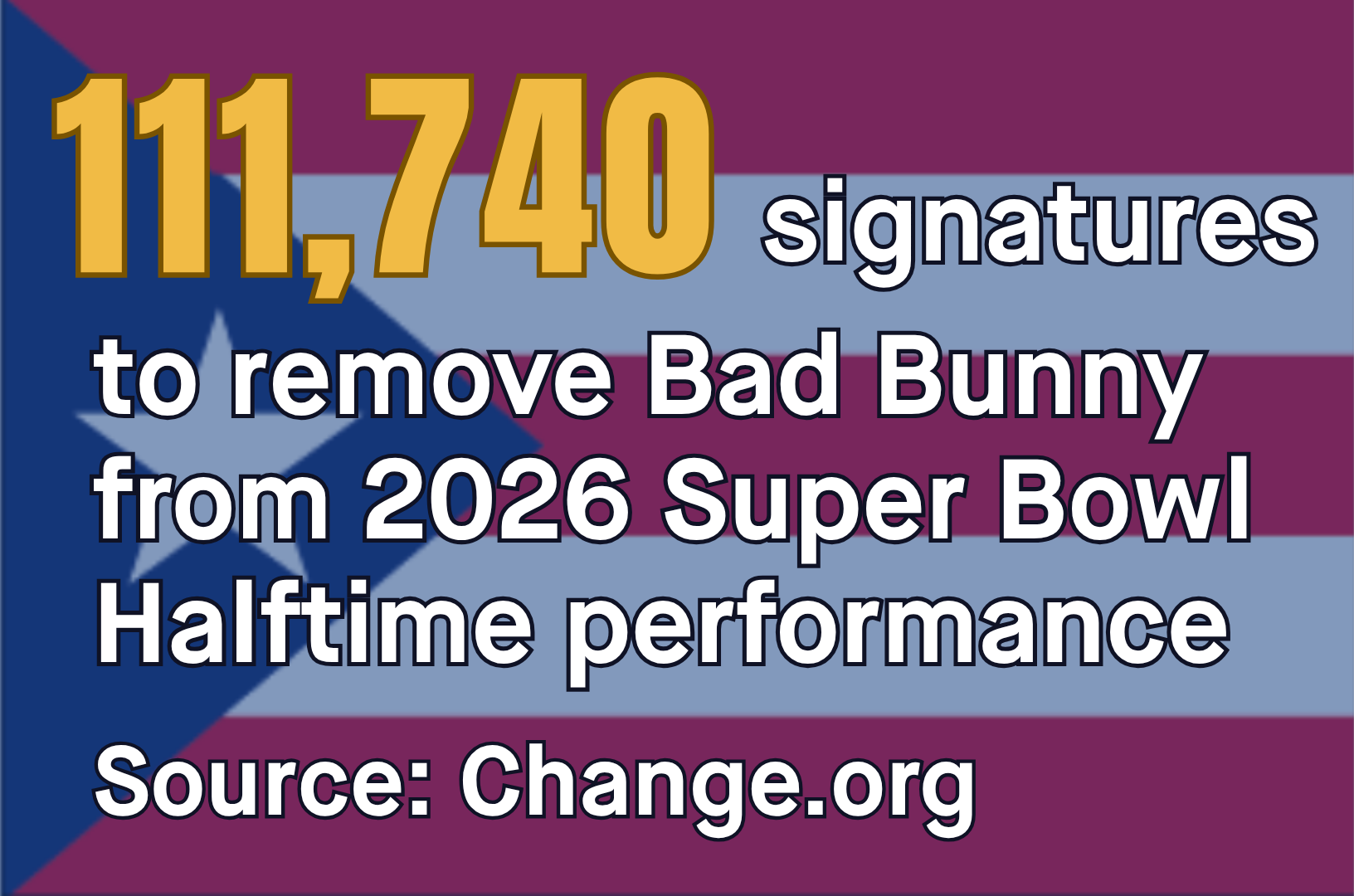
Criticism for being “un-American,” only singing in Spanish or failing to represent “family values” immediately followed the announcement. A Change.org petition to replace Bad Bunny with country music star George Strait received over 111,000 signatures. Many commenters also expressed dislike or unfamiliarity with his music.
 “He’s performing in Spanish, so to people who don’t understand Spanish, I can see that’s a viable concern,” Bad Bunny fan Tanay Agrawal (11) said. “I also think it’s just because he’s Latin American. In their minds he’s not American even though Puerto Rico is part of America.”
Although Puerto Rico is culturally and linguistically distinct from the mainland U.S., Bad Bunny holds U.S. citizenship. His political advocacy and criticism of the U.S. government over topics like ICE’s targeting of Latino communities and the government’s response to Hurricane Maria makes him a politically controversial figure in American politics. Spanish department chair Abel Olivas explained that Bad Bunny often uses his prominence to champion sociopolitical causes.
“He’s been an activist and a vocal supporter of various communities in the U.S. — the immigrant community, the Latino community, the LGBTQ+ community,” Olivas said. “So he’s been labeled by the far right and MAGA as an enemy. They won’t want him to be given a platform, given everything he represents.”
In response to criticism, the NFL has remained resolute in its decision due to the singer’s appeal to an international audience. LatinX Affinity Group Co-President Sofia Vasquez Perez (12) explained that the album embraces Puerto Rico’s cultural heritage and voices the island’s topical issues.
“The theme is the whitewashing of the Puerto Rican community,” Sofia said. “[His songs are] about family, about roots and missing home. His home is no longer what it was because so many people now, usually Caucasian, end up living there because it’s cheaper and affordable living and it’s tropical.”
With his last album, Bad Bunny shifted towards traditional Latin genres and sociopolitical messaging surrounding Puerto Rico, namely its issues with gentrification and its colonial relationship with the U.S. This evolution from his reputation for releasing mostly party music has cemented Bad Bunny into a relatable artist for many in the Hispanic community, who feel represented in his songs.
“He went from reggaeton music to something homier,” Sofia said. “He’s going back to the salsa roots of his Puerto Rican descent and traditional, older forms of music. So that change, whether that’s political or just him trying to make a new movement, is very different.”
Whereas Bad Bunny’s announced performance was met with backlash, Shakira and Lopez received a warm welcome ahead of their 2020 Super Bowl LIV Halftime Show. Their performance similarly highlighted themes of immigration policies and Hispanic culture, all while singing primarily in Spanish. Bad Bunny was even a guest performer there.
“Shakira is Colombian, and I remember people were excited,” Sofia said. “It’s also different between a showwoman and a showman. There was more backlash on J.Lo because people don’t think J.Lo is a good artist, but that’s it.”
This shift in Super Bowl fan behavior reflects that the U.S’s political climate is less accepting of minorities and foreigners compared to five years ago.
Bad Bunny chose not to plan any concerts in the continental U.S. for his upcoming international tour commencing Nov. 21, voicing concerns that his majority-Latino fanbase would be targeted by ICE at concerts. He instead hosted a month-long series of concerts in Puerto Rico from July to September, supporting its local economy and encouraging fans to travel to the island. This decision contributed to the perception that he “hates America.”
“He’s worried about the immigrant community, and ICE coming into his concerts and doing what he would see as discriminating and violating human rights,” Olivas said. “He’s not interested in creating that sort of situation, but it’s interesting that he’s willing to do the Super Bowl. But that’s a very different scenario since it’s a mixed group of people and not like a concert where a ton of Latinos will be showing up.”
Controversies around Bad Bunny’s performance reflect a large national tension over cultural representation in America. His upcoming performance comes at a time when discussions about immigration, language, and national identity are especially prominent in American politics.
“He’s shown a sense of power to those who can’t speak up around him,” Sofia said. “He is a citizen, but at the same time the Latin American community feels so connected to him and he’s such an advocate for immigrant communities. That’s what connects us to him. [The U.S.] is a land brought up by immigrants. We just have turned a blind eye.”