



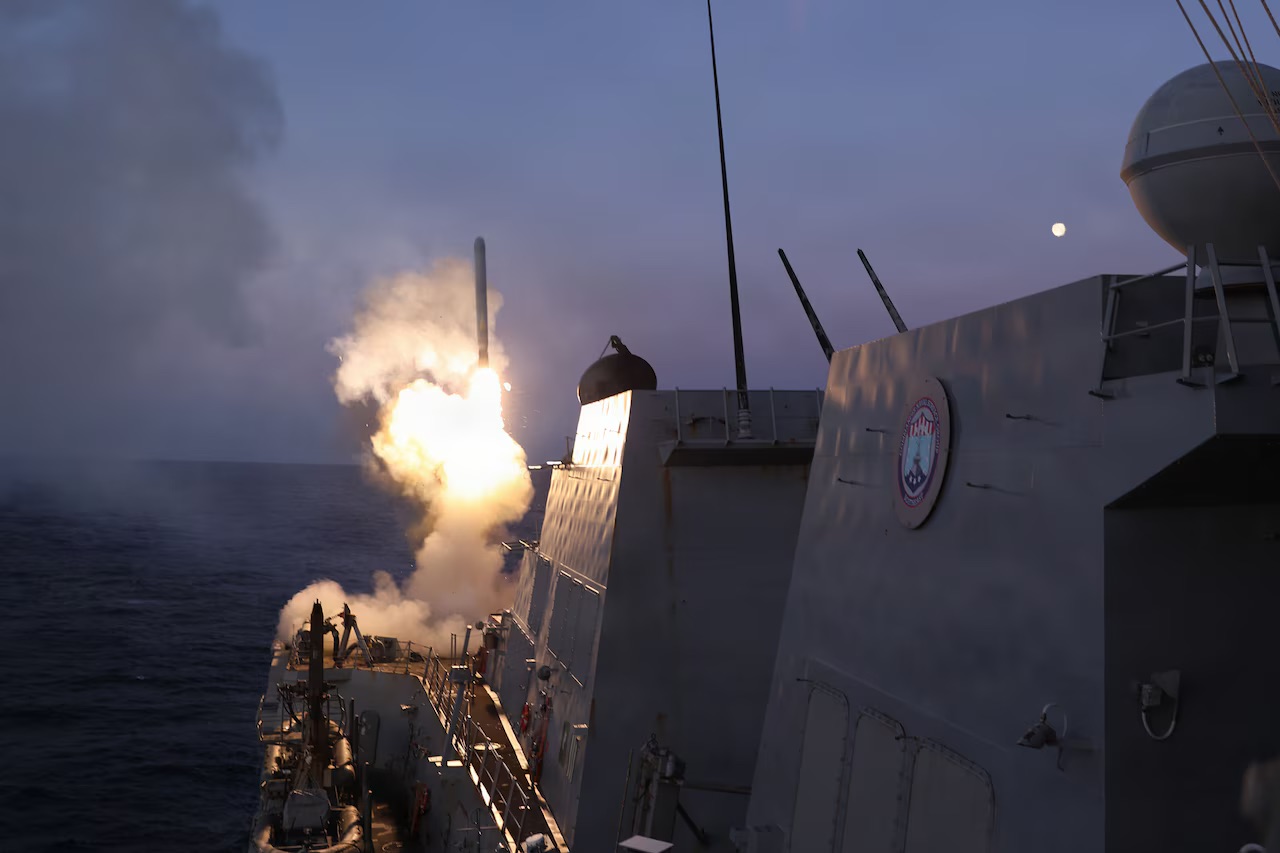
The U.S. and Israel continued launching strikes against Iran for the fourth consecutive week since the start of attacks on Feb. 28.
The conflicts, which began as an operation by the U.S. military named Operation Epic Fury, have killed more than 2,300 people in the region, including at least 1,300 Iranian civilians, 14 Israelis, 13 U.S. soldiers and Iran’s former Supreme Leader Ali Khamenei. Among the deadliest incidents was a strike on Shajareh Tayyebeh elementary girls’ school in Minab in southeastern Iran that killed more than 165 people.
Senior Tara Nemati, whose family is Iranian, expressed her concern for her relatives residing in Iran.
“We have a lot of family that still live in Tehran, and they all had to leave and go to residences outside the city to wait out the attacks,” Tara said. “For Iranian Americans, it feels like every other year, Iran is in the news, so it’s difficult to know how to feel. People are often asking: ‘Will this be the thing that topples the regime?’”
U.S. forces have struck more than 7,000 targets in Iran since the conflict began, while Iran has retaliated with hundreds of missiles and drones aimed at Israel and U.S. military bases across the Middle East.
President Donald Trump has claimed that Iran poses an “imminent” threat to the United States, citing justifications like preventing Iran from obtaining a nuclear weapon and securing Iran’s national resources. While some interpret the conflict as motivated by oil or territorial gain, others point to security concerns, including the U.S.’s longstanding alliance with Israel, which has long been in conflict with Iran.
“People attribute the attacks to the U.S. wanting oil,” sophomore SDC representative Ishaan Dhillon-Patel said. “This is true writ large, but in this case it’s the U.S. reintervening because of nuclear material weapons even after we’ve killed many of the nuclear scientists. A lot of people think the war is about the U.S.’ greed, when in reality it’s about Israeli security and our ties to Israel.”
The conflicts have created significant global economic consequences. More than 1,000 cargo ships were blocked from transiting the Strait of Hormuz, a critical international waterway for oil transport linking the Gulf of Oman and the Persian Gulf. Economics teacher Sam Lepler emphasized that disruptions in energy supply can quickly affect nearly every sector of the economy.
“If the Strait of Hormuz is closed, then oil cannot get out of the Persian Gulf, and that creates a shortage and shoots up oil prices,” Lepler said. “Almost everything requires gas either to move it from place to place or directly like petroleum-based products. The potential threat of higher oil prices is stagflation, where you would get higher unemployment and higher inflation.”
The war reflects the long-strained relationship between the U.S. and Iran, shaped by the 1979 Iranian Revolution, which established the Islamic Republic and broke diplomatic relations between the countries. Israel plays a central role due to its security rivalry with Iran and its alliance with the U.S.
“Iran and Israel’s relationship has soured quite a bit,” Ishaan said. “We’ve seen in the region that they haven’t really had the best relationship. Ultimately, I do think this will frame the U.S. in a different light. We lost our credibility — this conflict means that now no one trusts us to be a reliable ally. We’re attacking other countries because Israel told us to.”
The U.S. has not formally declared war on Iran, nor has Trump has requested congressional approval for the attacks. Iran’s Foreign Minister Abbas Araghchi has dismissed suggestions that Tehran is seeking a ceasefire. Without a reduction in violence or renewed diplomacy, the consequences of the conflict show no signs of abating.
“When the attacks first started up, everybody was hopeful because maybe something would finally change,” Tara said. “Now, as the messaging has become more contradictory from the Trump administration, I personally think there’s going to be a lot of destruction, and Iranians will be left to pick up the pieces. Their regime will be severely weakened but still powerful enough to suppress people, and I feel like they will continue trudging on in this continuously denigrating status quo.”