

Trump upends U.S. foreign policy


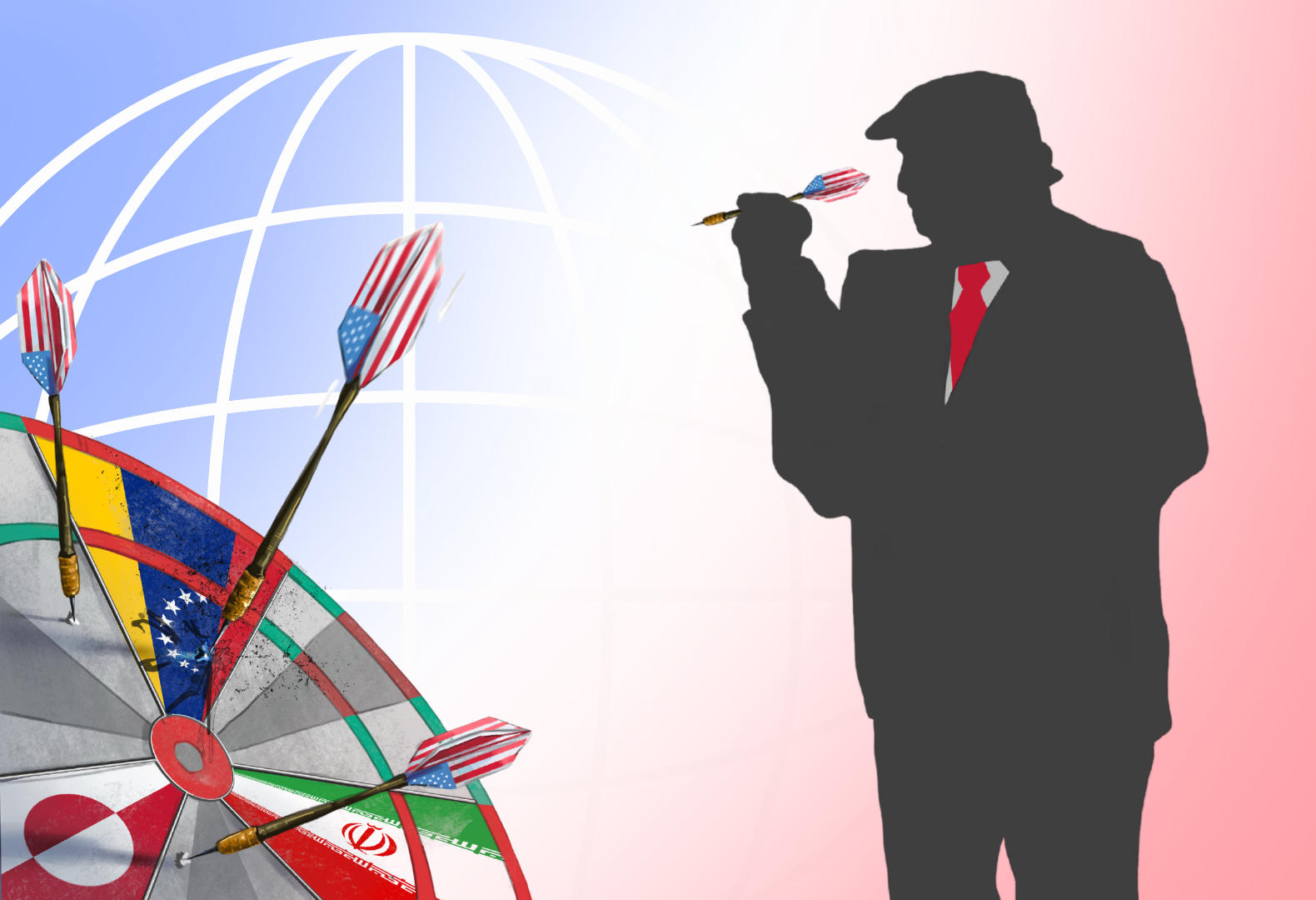
Since August 2025, the U.S. has increased its military presence in the southern Caribbean, deploying warships, military personnel and support aircraft to regional bases. Beginning in September, the military also began striking alleged drug-trafficking vessels in the Caribbean as part of an anti-narcoterrorism operation. These actions sparked bipartisan concern regarding the legality of killing civilians of foreign nations without due process.
Trump has long linked Venezuelan President Nicolás Maduro and his wife, First Lady Cilia Flores, to drug trafficking into the United States. During Trump’s first term, the Justice Department indicted Maduro on charges of conspiring with Colombian guerrilla groups to import cocaine. In July 2025, the Trump administration designated the Cartel of the Suns, a Venezuelan drug syndicate alleged to be led by Maduro, as a Foreign Terrorist Organization.
In the early hours of Jan. 3, more than 150 U.S. aircrafts launched airstrikes against infrastructure targets like military bases and air-defense systems. Simultaneously, in what was presented as a law-enforcement operation to bring the couple before U.S. courts, the U.S. Army’s Delta Force special operations unit captured Maduro and Flores at their compound in the capital, Caracas.
“Something like the Maduro ‘snatch and grab’ seems like an opportunity that he seized for an easy win,” Honors Modern International Affairs teacher Matt McCorkle said. “There is some precedent in the Panama-Noriega case, where we have prosecuted foreign nationals for violations of U.S. law. Support for Maduro, mostly among our political rivals who viewed him as a legitimate leader, is much stronger than in that case. However, we’ve seen significantly more international pushback, perhaps due to Trump’s willingness to speak positively about American territorial expansion.”
Compared to previous administrations, Trump primarily focused on restoring democratic processes in Venezuela rather than putting an end to the decades-long repression in the country. This is despite the disputed 2024 presidential election, in which Maduro was officially declared the winner of another six-year term. The results were widely viewed as manipulated, and verified vote counts showed that the opposition candidate, Edmundo González, had won instead.
“A very important thing to consider is that the U.S.’s intervention in Venezuela is not unprecedented at all,” junior Dhanya Ramanan said. “America has a long history of engaging in this kind of behavior, especially in South America. The bigger concern is the state of U.S. foreign relations in general. At the moment, the country is operating like a bull in a china shop. That is not how foreign policy should be conducted.”
Instead, Trump has pivoted toward engaging with Maduro’s successor, Delcy Rodríguez, and the broader socialist leadership, seeking to extract economic value from Venezuela’s vast but dormant oil infrastructure. Although the White House assembled Chevron, ExxonMobil and other oil and gas companies to encourage billions of dollars in investment to rebuild Venezuela’s energy sector, the financial and logistical burden of restoring and maintaining such infrastructure in a foreign country remains substantial.
“If you’re one of those American oil companies investing heavily in infrastructure in Venezuela, and years later, the Trump administration is gone, the Venezuelan government might once again declare it ‘the people’s property’ and renationalize it,” McCorkle said. “If I were a shareholder in an oil company announcing major capital expenditures in Venezuela, I would be very concerned about the longevity of those investments.”
Trump continued to challenge international norms by repeatedly threatening to annex Greenland, a North Atlantic Treaty Organization (NATO) ally. He initially refused to rule out using military force to seize the territory and threatened a trade war with the European Union. He later stated that these threats arose from not being awarded the 2025 Nobel Peace Prize, an honor which he attributed to NATO member Norway, despite the prize committee’s independence from the Norwegian government. Following bipartisan condemnation and a meeting with NATO Secretary General Mark Rutte, Trump backed down.
“Trump likes to use the limelight of foreign policy to send a message, and often it’s to get his base of supporters in MAGA rallied up,” speech captain Albert Yao (12) said. “However, a majority of Americans have already turned on Trump when it comes to economic matters, and that is a very serious political weakness for his grasp over the levers of power in American government and society. Especially with the tariffs on Greenland, he walked back his comments after his threats tanked the stock market and the U.S. Treasury Bonds market as well.”
Many administrations have recognized Greenland’s national security importance, particularly for missile detection and space surveillance, as well as its economic value because climate change-driven ice melt has unlocked shorter Arctic shipping routes.
“What we are trying to accomplish with Greenland is a little questionable because we already have the right to establish troops there,” McCorkle said. “If that’s all we want, we already have it. Natural resource seizure, acquisition and his focus on tariffs are very much relics of mercantilist policies of centuries past, which is an interesting perspective to take in the modern world.”
Trump, however, differed from previous administrations by explicitly framing the pursuit of these interests in terms of American expansionism, even at the expense of the U.S.’s closest NATO allies. These actions, fighting his own allies for a territory to which it already has full military access, have begun to erode the trust that forms the bedrock of the military and economic alliances that enables nations to counter external threats from Russia, China and other adversaries with unified strength.
“Greenland is great strategically speaking, great for the military and for trade,” Dhanya said. “The optimal way to have done that would have been to just be friends with Denmark. That was the usual strategy, but Trump’s actions will cause a lot of issues with allies. I can see this goal of asserting greater U.S. presence there that America’s presidents have set either being pushed back maybe 30 years, or it’s going to be something we’re never going to be able to achieve at all.”
Trump’s indifference toward his NATO and historical allies and willingness to instead prioritize his own interests has begun to alienate nations from the U.S. economically, militarily and diplomatically. Albert emphasized that criticism of NATO within the administration can undermine important partnerships.
“Many people in the Trump administration think that European countries have been freeloading off of U.S. defense spending and neglecting their own defense funds,” Albert said. “There is some truth in the statement, but Trump’s way of [addressing] this is not effective. The threats of tariffs and outright hostility is not a good look if we want to keep working with Europe, which we absolutely need. There’s key bases inside Europe in Germany and Portugal that are absolutely crucial for our logistic networks and power projection across the Atlantic.”
Mark Carney, Prime Minister of Canada — a NATO country and traditionally one of the U.S.’s closest allies — has argued that the rules-based international order of the past few decades was coming to an end and criticized what he perceived as American hegemony. He called for closer collaboration among middle powers to counteract the influence of the “great powers,” implicitly hinting at the U.S. Countries in the Caribbean, Latin America, Africa and the broader Global South have likewise expressed alarm, framing such intervention as a threat to sovereignty and international norms.
“International norms are very much based on consensus, and you can push those norms to a degree,” McCorkle said. “Take, for example, Russia and their moves toward Georgia and Ukraine. By the time they push to a full-on invasion in 2022, they are no longer welcome among some countries who even consider themselves friendly with Russia. If the administration continues pushing norms, even if you don’t view Maduro as a particularly legitimate head of state elected in a free and fair election, you might start to be worried. We have seen some guarded language among our allies about the U.S.’s actions in Venezuela.”