



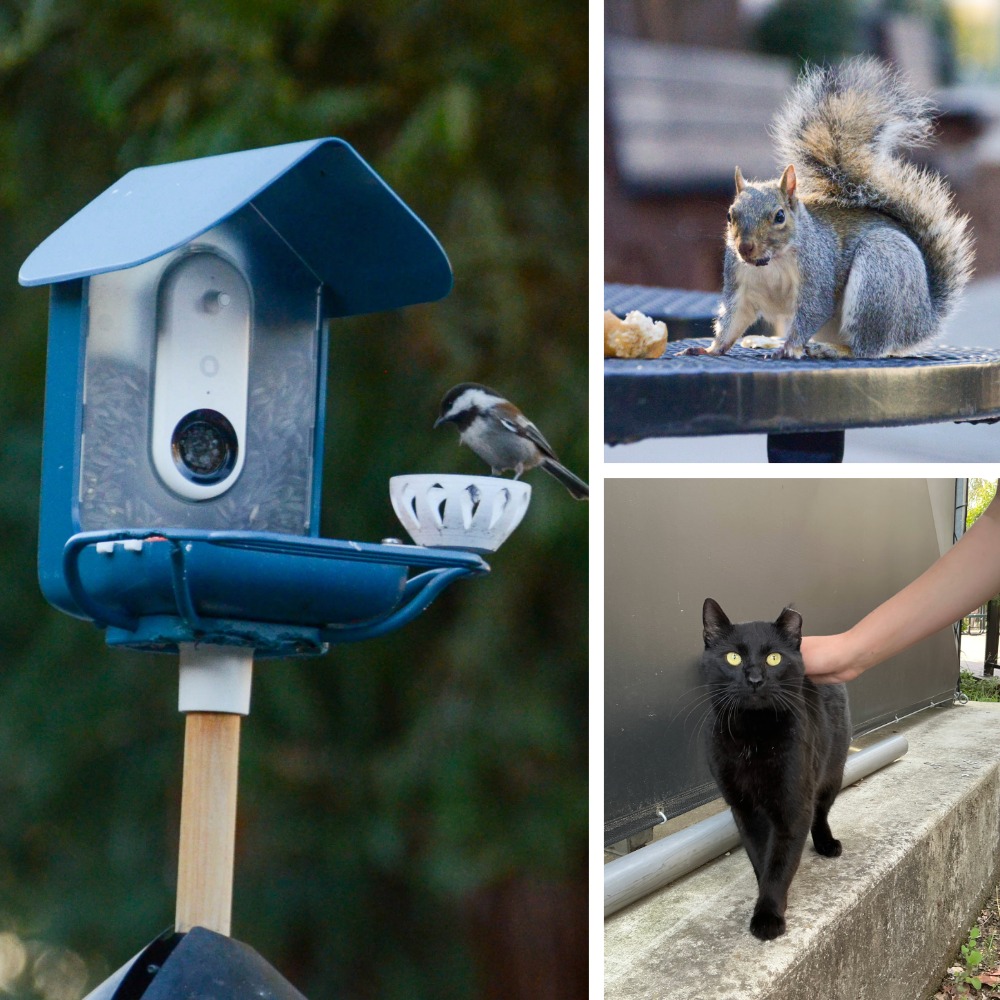
As the afterschool sandwich cart rolls off into Manzanita, beady eyes and bushy tails scramble across branches and twigs, making their way single-file to one place – the trash can. Tiny, furry hands emerging with a single nutella-covered knife, a squirrel gleefully darts in and out of the garbage, earning new spoils each visit.
Harker is home to a variety of animals — crows, squirrels and a litter of black cats. While it’s often hard to catch them between 8 and 3, one can almost certainly get a glimpse of Harker’s wildlife in the early mornings or late afternoons.
“I sit outside a lot, and the squirrels almost always come up to me,” Students for Ethical Treatment of Animals Co-President Aline Grinspan (12) said. “Seeing them makes me remember that any bit of wildlife belongs here just as much as we do, and I can see the connection between us and our environment.”
Near the end of the last school year, Upper School Director of Learning, Innovation, and Design Diane Main installed bird feeders around campus to help bring out more of Harker’s diverse bird species. She uses a special kind of bird feeder, nicknamed BirdBuddy, that has cameras installed inside for a better view of each bird that comes to visit. For Main, the videos from the feeders revealed insights about the characters of individual birds.
“Some of the birds have different personalities,” Main said. “Some are very nervous and jump, and some are kind of relaxed and confident. With regard to some of the classes, like biology, we can also observe their behaviors and see how animals are coexisting together too.”
As of today, there are two bird feeders with cameras behind Dobbins and several more regular ones around campus. Main also encourages students to check out Birds of Harker’s Instagram account to get more routine updates, or to visit and observe the feeders from a distance to avoid scaring off the birds.
“I love nature and I wanted to be able to have a space people could observe if they were interested,” Main said. “I think it’s also really helpful to remember that we share our environment with other creatures, not just humans.”
The little of black-and-white cats occasionally frequent the Upper School and are perhaps students’ favorite animals. With their docile, friendly natures and readiness to cuddle, seeing them is a highlight of campus life.
“It’s something that students have thoroughly enjoyed over the years,” Thiele said. “I gave a presentation during school meeting a few years ago and people told me it was one of the best school meetings they’ve attended. There [seems] to be an organic interest in the cats because they just add a bit of spice and flavor to the regular school day.”
The entire cat community on campus is believed to descend from Thiele’s adopted cat, Chaos, who unfortunately passed away in November. Her offspring, Athena and Tony, are well loved by students – lovingly named after Greek goddesses and Harker Mathematics department chair Anthony Silk.
The Harker Upper School campus is known for being a haven for squirrels, who opportunistically take advantage of every food-involved activity they can. Thanks to the bird feeders, trash cans, and abandoned lunch trays, the campus has become a goldmine of delicious – but not exactly nutritious – food.
In fact, it’s a common tale among students that the unhealthy food the squirrels ingest have caused them “mutate,” or has made them lack a sense of fear of students. Although spicy, irritating foods like cayenne pepper have been used for years to deter pests, Ms. Main notes that Harker’s squirrels have been known to willingly run up to students for a taste of their lunch, no matter the spiciness.
“I suspect that our really diverse food offerings are one of the reasons why the squirrels aren’t put off by cayenne pepper,” she said. “They’ve been eating Mexican food, Indian food, and all kinds of other foods that they’ve been digging out of the garbage for years.”
While the animals’ frequent visits truly do make them seem like just another part of campus life, it’s important to remember that these animals are still wild and must be treated as such. Students should avoid teasing, overfeeding, or disturbing the wildlife – actions that can alter animals’ typical feeding strategies.