



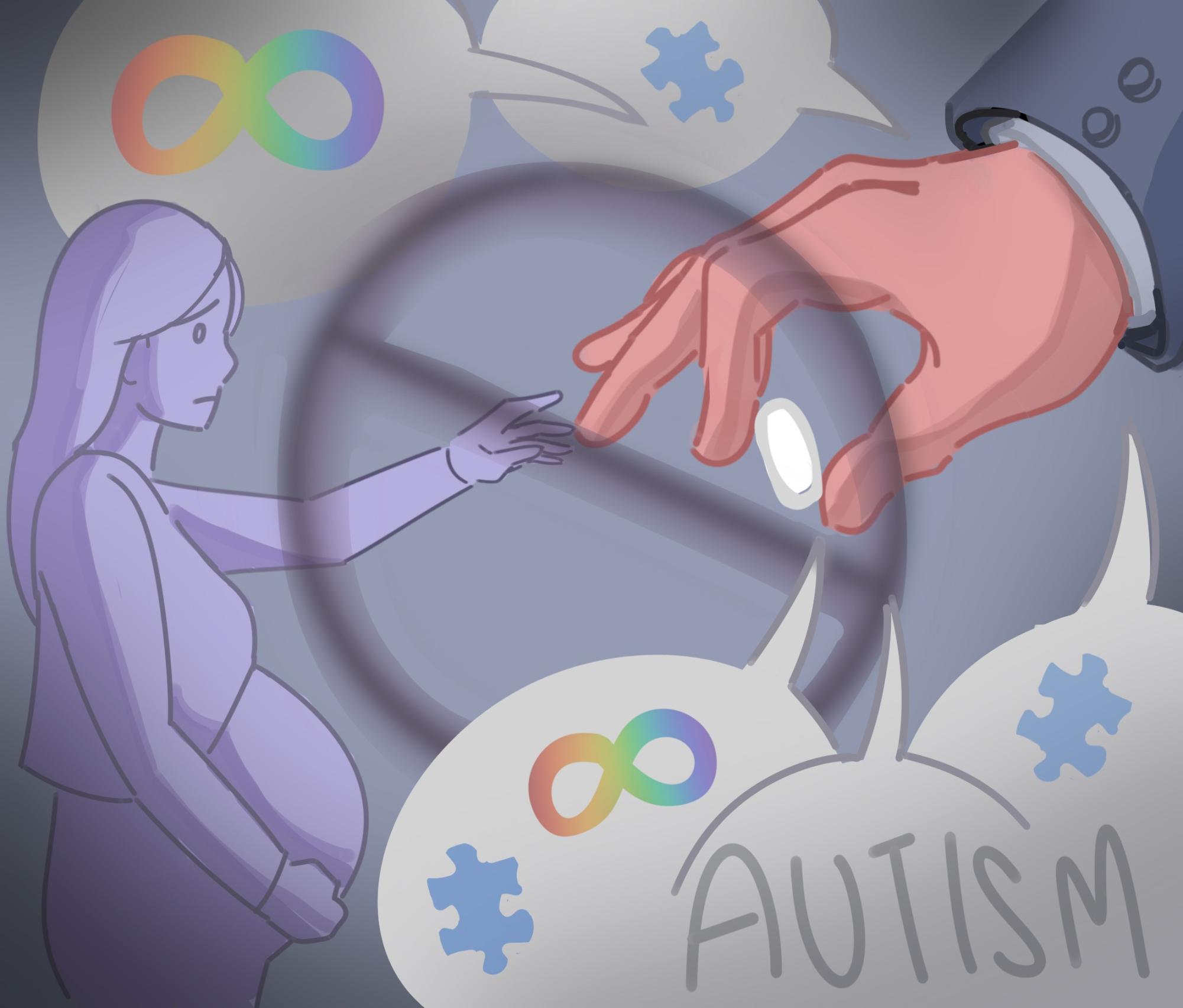
President Donald Trump claimed a link between acetaminophen — commonly known as Tylenol — and autism during a press conference on Sept. 21, sparking concerns over misinformation, women’s health and the politicization of science.
“Taking Tylenol is not good – I’ll say it, it’s not good,” Trump said during the press conference. He added that certain communities like the Amish had “no cases of autism.”
Scientists and physicians emphasize there is no confirmed causal link between acetaminophen use and autism. While some studies have observed probable harms from long-term acetaminophen exposure and pregnancy, the World Health Organization stated the evidence remains inconsistent and confounded by other factors. The American College of Obstetricians and Gynecologists continues to recommend acetaminophen as the safest pain and fever reliever for pregnant women when used according to the dosage.
Biology teacher Matthew Harley highlighted how Trump’s statements place fault on women for children with autism, a trait determined by a wide variety of both genetic and environmental factors.
“There’s the larger picture of the public taking this as blaming women for autism: ‘It’s the pregnant mom’s fault that these children have autism.’” Dr. Harley said. “It can lead to more control over women while they’re pregnant instead of them having their autonomy to lead their pregnancy as they wish, including their pain tolerances and whether they take Tylenol.”
Trump also announced that the Food and Drug Administration (FDA) would update drug labeling to discourage pregnant women from using the commonly-used over-the-counter painkiller. However, the FDA said in a press release that “the choice still belongs with parents” and has not changed its labeling of acetaminophen.
Acetaminophen currently remains the only over-the-counter pain-relief medication approved for use in fevers during pregnancy. When left untreated, fevers can cause neural tube defects in pregnant women, which harm both the mother and baby. Lack of pain medication also significantly increases psychological stress during pregnancy, which can lead to miscarriages.
Medical experts warn such remarks risk spreading misinformation and undermining trust in proven medical practices. Learning Specialist Kadar Arbuckle, who works with neurodiverse students in navigating both school and family life, added that cultural context impacts how likely individuals are to believe this type of messaging.
“It’s easy for me to look at it and go, ‘there’s no real medical evidence here,’” Arbuckle said. “So I can dismiss it, but there are a lot of people throughout the country, throughout the world who are probably not reacting in that way, and it’s confirming the biases they already have.”
With autism already facing stigma, Trump’s rhetoric deepens misconceptions and isolates the neurodiverse community.
“Autism’s not this bad thing, it’s just a part of someone’s being, a part of how they behave and how they act,” Arbuckle said. “When I read between the lines, I see there’s something wrong with ‘don’t take Tylenol or else this bad thing will happen.’ That’s a much bigger issue than even the lack of evidence.”
Trump’s comments have reignited debate over how political messaging influences public health. While the FDA still hasn’t confirmed any rule changes, the president’s directive traps them between political pressure and unfounded claims.
Medical Club officer Ava Chang (10) suggests that the public should be more vigilant about analyzing political statements for their accuracy.
“Because health and medicine requires a lot of evidence, no matter how politically powerful somebody is, the public shouldn’t fully trust them if their claims aren’t backed up with evidence and trial data,” Ava said.
As the president’s comments ripple through social media and medical circles, many citizens fear the familiar challenge ahead — how to separate science from politics when the two are increasingly intertwined.